From Power to Connectivity: Breaking Down Data Center Components Seattle–Tacoma
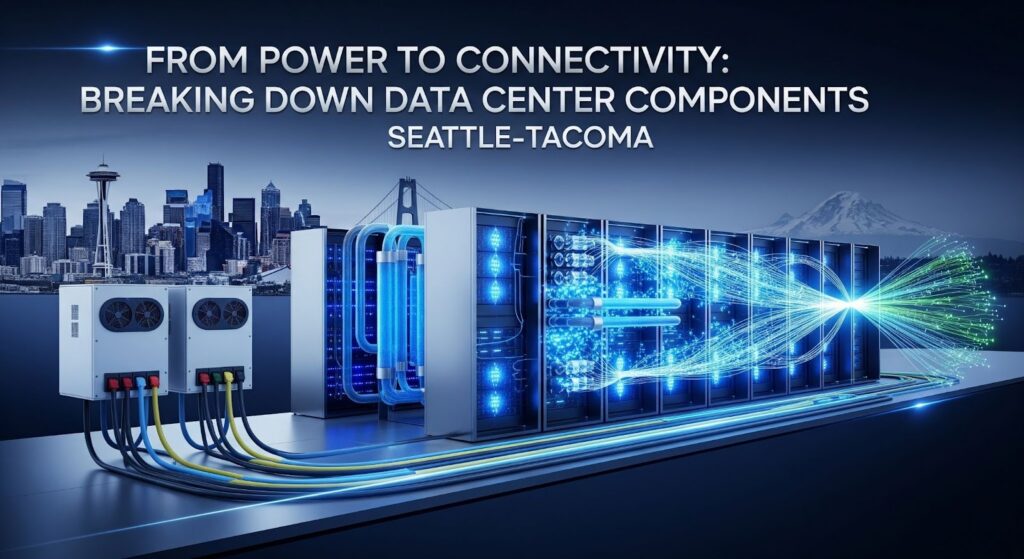
The Pacific Northwest’s data center components Seattle-Tacoma market continues expanding as businesses demand reliable infrastructure solutions. From power systems to cooling mechanisms, understanding these critical data center components Seattle-Tacoma facilities offer helps organizations make informed decisions about their infrastructure needs. Whether you’re exploring colocation options or planning enterprise infrastructure, this comprehensive guide breaks down everything you need to know about data center components Seattle-Tacoma businesses rely on.
What Are the Essential Data Center Components in Seattle-Tacoma?
Data center components Seattle-Tacoma facilities encompass power distribution systems, cooling infrastructure, connectivity equipment, security systems, and environmental controls that ensure 99.9% uptime for critical business operations.
Modern data center components Seattle-Tacoma facilities integrate multiple interconnected systems to support today’s digital infrastructure demands. These components work together seamlessly to maintain optimal performance levels while minimizing operational costs.
The region’s strategic location near Sea-Tac International Airport and major fiber networks makes it ideal for enterprise data center deployment. Leading providers like Reboot Monkey, Sabey data center locations, and Centeris data center operate state-of-the-art facilities throughout the area, with Centeris data center Puyallup serving as a key regional hub.
Core Infrastructure Components
Essential data center components include:
- Power systems: UPS units, generators, PDUs, and electrical distribution
- Cooling systems: HVAC units, chillers, CRAC systems, and containment solutions
- Network infrastructure: Switches, routers, fiber connections, and bandwidth management
- Security systems: Biometric access, surveillance cameras, and fire suppression
- Environmental controls: Temperature monitoring, humidity management, and air filtration
Power Infrastructure: The Foundation of Data Center Components Seattle-Tacoma
Power infrastructure represents the most critical data center component, typically accounting for 30-40% of operational expenses while requiring redundant systems to prevent costly downtime incidents.
Data center components Seattle-Tacoma facilities leverage redundant power feeds from multiple utility sources to ensure continuous operations. Most facilities implement N+1 or 2N redundancy configurations, meaning backup systems exceed primary capacity requirements.
| Component | Function | Redundancy Level |
| UPS Systems | Immediate backup power | N+1 redundancy |
| Generators | Extended outage protection | 2N configuration |
| PDUs | Power distribution | Dual-feed setup |
| Electrical Panels | Circuit management | Redundant feeds |
Facilities like Centeris data center Puyallup and Sabey data center locations implement advanced power monitoring systems that track real-time consumption and predict maintenance needs before issues arise.
Ready to explore reliable data center components Seattle-Tacoma solutions? Contact Reboot Monkey for expert consultation on your infrastructure needs.
Power Distribution Architecture
Data center components Seattle-Tacoma careers are expanding as facilities require specialized technicians for power system maintenance. Reboot Monkey’s smart hands services include comprehensive power system maintenance, ensuring optimal performance across all distribution levels. Our certified technicians monitor power quality metrics and perform preventive maintenance to maximize uptime.
Cooling Systems: Managing Heat in Pacific Northwest Data Centers
Cooling systems consume approximately 40-50% of total data center power while maintaining optimal operating temperatures between 68-77°F for IT equipment longevity and performance.
The Seattle-Tacoma region’s mild climate provides natural cooling advantages, allowing data centers to implement economizer systems that reduce mechanical cooling requirements during cooler months.
Advanced Cooling Technologies
Modern facilities deploy multiple cooling strategies:
Air-based cooling utilizes computer room air conditioning (CRAC) units and containment systems to manage airflow efficiently. Hot aisle/cold aisle configurations optimize cooling distribution while reducing energy consumption.
Liquid cooling systems handle high-density computing loads by directly cooling components with chilled water or specialized coolants. This approach proves especially effective for AI and high-performance computing workloads.
Free cooling leverages outside air during favorable weather conditions, significantly reducing mechanical cooling costs during Seattle’s moderate climate periods.
| Cooling Method | Efficiency Rating | Best Use Case |
| Air-based CRAC | PUE 1.4-1.8 | Standard density |
| Liquid cooling | PUE 1.2-1.4 | High-performance computing |
| Free cooling | PUE 1.1-1.3 | Seasonal optimization |
Spokane data center facilities often implement hybrid cooling approaches combining multiple technologies for optimal efficiency across varying seasonal conditions. Understanding data center components Seattle-Tacoma cooling requirements helps businesses optimize their infrastructure investments.
Network Connectivity: Seattle-Tacoma’s Digital Highway
Network connectivity components enable data transmission speeds up to 100 Gbps through redundant fiber pathways connecting Seattle-Tacoma facilities to global internet exchanges and cloud providers.
The region benefits from extensive fiber infrastructure connecting major carrier hotels including the Westin Building Exchange in Seattle. This connectivity ecosystem supports low-latency applications and disaster recovery implementations.
Connectivity Infrastructure Elements
Fiber optic cables provide the backbone for high-speed data transmission between facilities and external networks. Multiple fiber paths ensure redundancy and prevent connectivity disruptions.
Network switches and routers manage traffic flow within data centers and to external destinations. Top-of-rack switches connect servers while core routers handle inter-facility communications.
Cross-connects enable direct connections between colocation customers and network service providers, reducing latency and improving performance for mission-critical applications.
Need expert network infrastructure support? Reboot Monkey’s remote hands services provide 24/7 network monitoring and rapid issue resolution across data center components Seattle-Tacoma facilities.
Security Components: Protecting Critical Infrastructure
Physical and logical security systems protect data center assets through multi-layered approaches including biometric access control, 24/7 monitoring, and advanced fire suppression technologies.
Data center components Seattle-Tacoma facilities implement comprehensive security measures addressing both physical threats and cybersecurity concerns. These systems work together to maintain compliance with industry standards like SOC 2 and HIPAA.
Physical Security Layers
Perimeter security includes fencing, lighting, and camera surveillance to monitor facility exteriors. Many facilities employ security personnel and integrate with local law enforcement for rapid response capabilities.
Access control systems utilize biometric scanners, key cards, and mantrap entries to restrict unauthorized facility access. Visitor management systems track all personnel movements within secure areas.
Fire suppression systems protect valuable equipment through clean agent suppression that won’t damage sensitive electronics. Environmental monitoring detects smoke, temperature changes, and water leaks before they cause damage.
Environmental Controls and Monitoring
Environmental control systems maintain optimal operating conditions through continuous monitoring of temperature, humidity, air quality, and vibration levels across all facility areas.
These systems prevent equipment damage while optimizing performance through real-time adjustments. Automated alerts notify facility managers of any environmental deviations requiring immediate attention.
| Environmental Factor | Optimal Range | Monitoring Frequency |
| Temperature | 68-77°F | Continuous |
| Humidity | 45-65% RH | Every 5 minutes |
| Air Quality | < 5% particulates | Real-time sensors |
Reboot Monkey provides comprehensive environmental monitoring services, ensuring your colocation environment maintains optimal conditions for sensitive data center components Seattle-Tacoma equipment operation requires.
Choosing the Right Data Center Components Seattle-Tacoma
Selecting appropriate data center components depends on workload requirements, budget constraints, compliance needs, and growth projections for your specific business applications.
Consider these factors when evaluating data center components Seattle-Tacoma options:
Power requirements vary significantly between standard business applications and high-performance computing workloads. Calculate both current needs and future growth to avoid costly infrastructure changes.
Cooling needs depend on equipment density and heat generation patterns. High-density deployments may require specialized cooling solutions beyond standard CRAC systems.
Connectivity requirements should account for bandwidth needs, latency sensitivity, and redundancy requirements. Mission-critical applications benefit from multiple network paths and carrier diversity.
Planning your data center components Seattle-Tacoma strategy? Reboot Monkey offers expert consultation services to help optimize your infrastructure investment across regional facilities.
Future Trends in Data Center Components Seattle-Tacoma
The evolution toward edge computing, AI workloads, and sustainability initiatives drives continuous innovation in data center components Seattle-Tacoma design and implementation.
Artificial intelligence applications require specialized cooling and power infrastructure to support GPU-dense computing clusters. Data center components Seattle-Tacoma facilities are adapting infrastructure to meet these demanding requirements, with many exploring data center components Seattle-Tacoma jobs opportunities in AI infrastructure management.
Sustainability focus encourages implementation of renewable energy sources, advanced cooling efficiency, and waste heat recovery systems. Many facilities target carbon neutrality through innovative component designs.
Edge computing growth necessitates smaller, distributed data centers with standardized component packages that enable rapid deployment and management.
Frequently Asked Questions
What makes data center components Seattle-Tacoma unique?
Data center components Seattle-Tacoma benefit from the region’s mild climate, abundant hydroelectric power, and extensive fiber infrastructure. These advantages enable higher efficiency cooling systems, lower power costs, and excellent connectivity options compared to other regions.
How do I determine the right power capacity for data center components Seattle-Tacoma?
Calculate your total IT load, add 20-30% for growth, then factor in cooling and infrastructure overhead. Consider both average and peak power consumption patterns. Reboot Monkey’s capacity planning services help optimize your data center components Seattle-Tacoma power infrastructure investment.
What redundancy levels should I expect from Seattle-Tacoma data center components?
Tier III facilities provide N+1 redundancy for critical components, while Tier IV facilities offer 2N redundancy. This means backup systems match or exceed primary system capacity, ensuring continuous operations during maintenance or component failures.
How important is cooling efficiency in Seattle-Tacoma data centers?
Cooling efficiency directly impacts operational costs and environmental sustainability. The region’s moderate climate enables economizer cooling strategies that reduce mechanical cooling requirements by 30-40% annually compared to warmer climates.
Can data center components be upgraded without service interruption?
Modern facilities design components for hot-swappable maintenance and upgrades. Power systems, cooling units, and network equipment can typically be serviced without affecting customer operations through redundant system designs.
What security standards apply to data center components Seattle-Tacoma?
Facilities comply with SOC 2, HIPAA, PCI-DSS, and other relevant standards depending on customer requirements. Security components include biometric access control, 24/7 monitoring, and environmental protection systems meeting these compliance frameworks. Many facilities also provide data center components Seattle-Tacoma address verification for compliance documentation.
Conclusion
Understanding data center components Seattle-Tacoma facilities offer helps businesses make informed infrastructure decisions that support long-term growth and operational efficiency. From robust power systems to advanced cooling technologies and comprehensive security measures, the region provides world-class infrastructure solutions for data center components Seattle-Tacoma deployments.
The Pacific Northwest’s strategic advantages in climate, power, and connectivity make it an ideal location for mission-critical data center deployments. Whether you need colocation services, remote hands support, or comprehensive infrastructure management, choosing the right provider ensures optimal performance and reliability.
Ready to leverage Seattle-Tacoma’s premier data center infrastructure? Contact Reboot Monkey today to discuss your specific requirements and discover how our smart hands, colocation, and remote support services can optimize your data center components for maximum performance and efficiency.