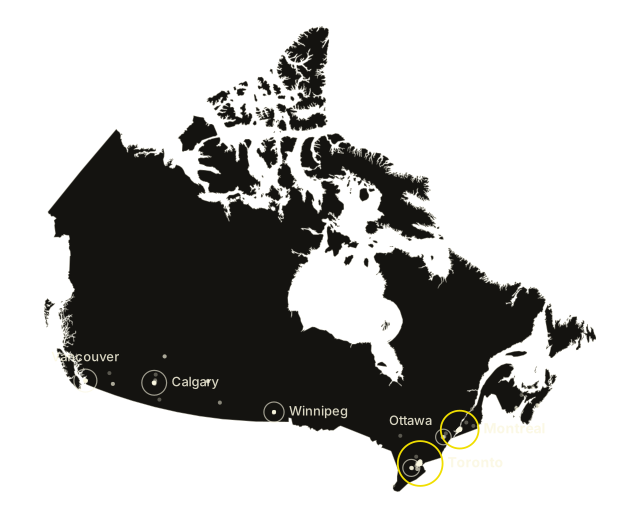
Map: Natural Earth
ITAD
ITAD in Canada: IT Asset Disposition
ITAD in Canada is the end-of-life handling of a customer's IT hardware. Reboot Monkey collects retired equipment at the customer's site or data centre, transports it for processing, wipes or physically destroys the storage media, and quotes resale or buyback case by case.
9
of our services in Canada
In depth
ITAD: 7 sections, open any to read more.
ITAD in Canada: How It Works
IT asset disposition (ITAD) is the end-of-life handling of a customer's IT hardware: collection and transport, data wiping or physical destruction of the storage media, and resale or buyback of the equipment that can be used again. For an organisation in Canada, it is the work that follows the decision to retire servers, storage and network equipment. It settles what happens next to every device and to the data that the device held.
Reboot Monkey is a third-party datacenter services operator, and ITAD is a physical service that it delivers. A request begins with the customer describing the hardware to be retired, where it stands, and what has to happen to its storage media. Collection takes place at the customer's site or data centre.
Processing is carried out by Reboot Monkey staff, either in a partner's processing facility or on the customer's site. Location is therefore the first question in an ITAD request: whether the media are handled where the equipment stands or after it has been transported. The answer determines which methods are open for the storage media, because shredding and degaussing take place on the customer's site.
A CTO, IT director or procurement manager approving an ITAD job needs a clear answer on each of these points before sign-off: where the hardware is handled, which method applies to the storage media, and how the value of reusable equipment is treated. The first two are settled when the job is set up. The third is a resale or buyback quote given case by case.
ITAD applies to hardware that is leaving service, and it is delivered as a service in its own right. Server migration and data center decommissioning are separate services: the first concerns equipment that moves, and the second concerns hardware that is removed from a facility. ITAD covers the hardware and its data once the equipment has been retired, whether it is collected from an office, a server room or a data centre.
The scope can range from a few retired servers to the contents of a room. What changes from job to job is the volume of hardware and the number of devices that held personal data, and Reboot Monkey scopes the work from the description the customer gives.
Personal Data on Retired Drives in Canada
In Canada, personal data on retired drives falls under the Personal Information Protection and Electronic Documents Act of 2000, overseen by the Office of the Privacy Commissioner of Canada. That sets the context for every ITAD job here: a drive taken out of service is still a drive that can hold personal data, and the data remains on the media until something is done to it.
Servers and storage systems retired from production can hold customer records, employee records and the contents of databases and file shares. The hardware may leave the rack, the room or the building, but the data goes with it unless the storage media are wiped or destroyed. The handling of the media is therefore part of the ITAD request, not a step added afterwards.
The Act and the Office of the Privacy Commissioner of Canada define the obligation on the customer's side. Reboot Monkey does not interpret the Act for a customer. Its side of the job is physical: collecting and transporting the hardware, wiping or destroying the storage media, and processing the equipment. What the Act requires of a particular organisation and a particular set of drives is a question for that organisation's privacy officer or legal counsel.
Storage media in an ITAD job are handled by data wiping or by physical destruction, and these routes have different consequences. Data wiping leaves the drive intact, so the drive stays with equipment that can be used again and can be part of resale or buyback. Physical destruction does not: on the customer's site, storage media can be destroyed by shredding or degaussing, and destroyed media no longer return to use. Choosing between the routes is therefore also a choice about how much of the equipment remains to be resold.
The method is set when the job is scoped, so the request names the devices that held personal data and the drives that did not. A single collection can include both routes, with some drives wiped and others destroyed. Where wiping is carried out, on the customer's site or in a partner's processing facility, is settled in the same step, and Reboot Monkey staff then carry out the method set for each device.
How Collection and Destruction Work
An ITAD request follows the sequence of the work itself, from the first conversation with the customer to the point where equipment is wiped, destroyed or resold. Reboot Monkey engineers are dispatched to the customer's site or data centre for the physical part of the job.
- Request: the customer describes the hardware to be retired and where it stands, whether that is the customer's own site or a data centre, and states which storage media hold personal data. Reboot Monkey scopes the job from that description.
- Collection and transport: Reboot Monkey collects the retired hardware at the customer's site or data centre and transports it for processing. In a data centre, the facility operator owns and runs the building, including its power, cooling and access policy, and Reboot Monkey engineers work under the operator's site rules.
- Processing: Reboot Monkey staff process the hardware, either in a partner's processing facility or on the customer's site.
- Data wiping: storage media that are wiped can stay with equipment that can be used again.
- Shredding or degaussing: on the customer's site, storage media can be destroyed physically by shredding or degaussing.
- Resale or buyback: equipment that can be used again is offered for resale or buyback.
Data Security in Canada
Data security in an ITAD job comes down to where the storage media are at each point in the job, who handles them there, and what is done to them before the equipment is used again or destroyed. Each of these can be stated in the request and carried out as an instruction.
At the customer's site or data centre, Reboot Monkey collects the retired hardware. On the customer's site, storage media can also be destroyed physically by shredding or degaussing. Where the job is processed on the customer's site, Reboot Monkey staff carry out the processing in the same place, so the storage media are handled where the equipment stands. For hardware standing in a data centre, the request should name the facility and the rack or room the equipment comes from.
In transit, Reboot Monkey transports the retired hardware for processing. This leg applies to hardware that is processed away from the customer's site, in a partner's processing facility. The customer's request states whether that route is acceptable for the devices concerned, in particular for those that held personal data.
At processing, Reboot Monkey staff handle the hardware, whether in a partner's processing facility or on the customer's site. Data wiping is carried out by Reboot Monkey staff at this stage.
The customer sets the instruction: which devices go, which media hold personal data, whether media are to be destroyed on the customer's site, and whether reusable equipment is offered for resale or buyback. Reboot Monkey carries out that instruction with its own staff and keeps collection, transport and processing within its own service.
The ITAD scope covers collection and transport, data wiping or physical destruction of the storage media, and resale or buyback. It does not replace the customer's own information-security policies, which remain the customer's to define. The Canadian element of the job is the legal setting for personal data, while the physical handling follows the service definition.
Why Reboot Monkey for ITAD in Canada
Equipment that reaches ITAD was installed and supported earlier in its life. Reboot Monkey sells rack space, IP transit, leased IP addresses, network, data-centre hardware and the services that deliver, install and support them, inside data centres that other companies own and run. It is not a hosting company and it is not a datacenter owner, so retired hardware is collected from the customer's own site or from a data centre that the customer uses. ITAD is the service at the end of that sequence.
The services around the rack that Reboot Monkey delivers are:
- Rack and stack: installing, mounting and cabling new hardware, which is the start of the life that ITAD closes.
- Remote hands: physical tasks carried out on the customer's instruction (reboots, cable checks, component swaps, visual checks).
- Smart hands: technical work that needs diagnostic judgement and configuration knowledge.
- Hardware monitoring: monitoring of the customer's servers and network equipment by the Reboot Monkey NOC.
- Server migration: moving equipment between racks, rooms or facilities.
- Data center decommissioning: removing and disposing of retired hardware.
How Reboot Monkey Handles IT Asset Disposition
These terms apply to IT asset disposition in Canada.
- Where the work is done: the processing is done by Reboot Monkey's own staff, in a partner's processing facility or on the customer's site, agreed case by case.
- Resale and buyback: reusable hardware can be resold through Reboot Monkey's procurement desk or bought back, quoted case by case.
Data sanitization and certificates
The data centres we work in hold their own certifications, such as ISO/IEC 27001 and ISO 9001. Ask us for the certificate of your site. Our ITAD partner's sites include facilities certified to ISO 9001, ISO 14001, ISO/IEC 27001 and ISO 45001. Ask us for the certificate of the site that handles your job.
- NIST SP 800-88 data sanitization
- Certificate of Destruction issued per storage device processed
Frequently Asked Questions
What does IT asset disposition cover in Canada?
IT asset disposition in Canada covers the end-of-life handling of a customer's IT hardware: collection and transport, data wiping or physical destruction of the storage media, and resale or buyback of equipment that can be used again. Reboot Monkey collects the hardware at the customer's site or data centre, and its staff process it on the customer's site or in a partner's processing facility.
Where does Reboot Monkey process retired hardware in Canada?
The processing is done by Reboot Monkey's own staff, in a partner's processing facility or on the customer's site, agreed case by case. The customer and Reboot Monkey settle which of the two applies before the job is scheduled, and the collection and transport of the hardware are arranged with the customer.
Can retired hardware be resold or bought back in Canada?
Yes. Reusable hardware can be resold through Reboot Monkey's procurement desk or bought back, quoted case by case. Send the list of the hardware, with models and quantities, through the contact form, and Reboot Monkey replies with what can be resold or bought back.
How do I get a quote for IT asset disposition in Canada?
Prices are quoted on request and depend on the customer and the size of the job. Send the site, the list of the hardware and whether storage media must be destroyed on site through the contact form, and Reboot Monkey replies with a quote for the job.
Request ITAD in Canada
Describe the hardware to be retired, where it stands and how its storage media should be handled, and Reboot Monkey will scope the job.