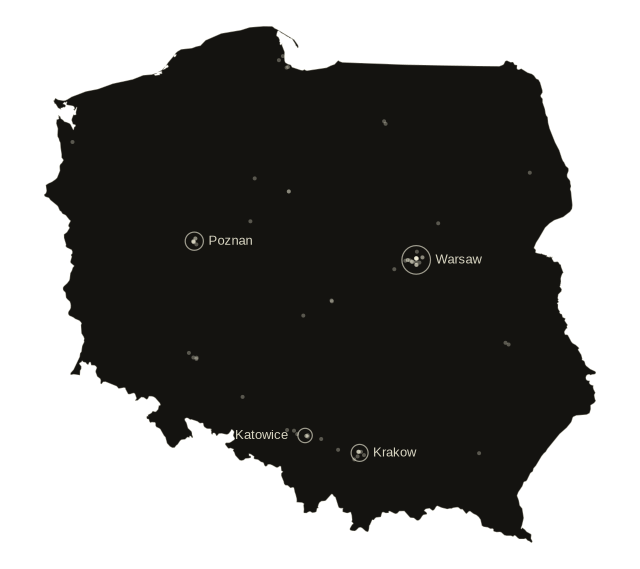
Map: Natural Earth
ITAD
ITAD in Poland: IT Asset Disposition by Reboot Monkey
ITAD in Poland is the end-of-life handling of a company's IT hardware: collection and transport, data wiping or physical destruction of the storage media, and resale or buyback of the equipment that can be used again. Reboot Monkey collects retired hardware at the customer's site or data centre and transports it for processing.
9
of our services in Poland
In depth
ITAD: 7 sections, open any to read more.
ITAD in Poland: How It Works
A retired server, switch or storage array leaves a rack with open questions: where the hardware goes, and what happens to the data on its drives. Reboot Monkey handles both in a single job. IT asset disposition (ITAD) is the end-of-life handling of a customer's IT hardware: collection and transport, data wiping or physical destruction of the storage media, and resale or buyback of the equipment that can be used again.
A request starts with a description of the hardware to be retired and where it stands, either at the customer's own site or in a rack in a data centre. Reboot Monkey scopes the job from that description. The quote is given on request and depends on the customer and the size of the job. Resale or buyback is quoted case by case, so the value of equipment that can be used again is settled for each job and not assumed in advance.
A request moves through these stages:
- Request: the customer names the hardware, its location and the handling wanted for the storage media.
- Collection: Reboot Monkey collects the retired hardware at the customer's site or data centre.
- Transport: the hardware is transported for processing.
- Data handling: storage media are wiped, or destroyed physically by shredding or degaussing when the work is done on the customer's site.
- Resale or buyback: equipment that can be used again is quoted case by case.
E-waste Rules in Poland
In Poland, electronic waste falls under the Ustawa z dnia 11 września 2015 r. o zużytym sprzęcie elektrycznym i elektronicznym, the Polish act on used electrical and electronic equipment. For a CTO or IT director planning a refresh or a data centre exit, this act is the legal reference for retired servers, network equipment and storage that leave service.
Reading and applying the act is a task for the customer's own legal and environmental advisers. What Reboot Monkey contributes to that work is a defined physical scope: which units are collected, from which location, how their storage media are handled and what happens to equipment that can be used again.
The request is where that scope is set. It should list the hardware by type and quantity, state where it stands, and say whether storage media are to be wiped or destroyed physically. Collection takes place at the customer's site or data centre, so the request also names the location to which Reboot Monkey engineers are dispatched.
Retired does not always mean discarded. Equipment that can be used again goes to resale or buyback, while equipment that cannot be used again is disposed of. The distinction is made for each job, and resale or buyback is quoted case by case.
A disposal job also needs a record of what left the rack. Asset inventory means recording the customer's equipment in the data center by serial number, asset tag and rack position, against the customer's asset list. Done before collection, it gives the customer a list to match against the hardware that is collected.
The act and the job meet at the moment of collection. Until then the hardware is the customer's equipment, at the customer's site or in the customer's rack, and the customer decides when it is retired. Transport and processing follow collection.
Hardware from a live refresh and hardware from a full data centre exit follow the same route. The difference is volume, which is why the quote depends on the size of the job. Reboot Monkey does not state a figure for a job of unknown size; it quotes once the scope is known.
Personal Data on Retired Drives in Poland
In Poland, personal data on retired drives falls under the General Data Protection Regulation (Regulation (EU) 2016/679), overseen by the Personal Data Protection Office. A drive keeps its contents after the server that held it is switched off and unracked, so retired drives are the point at which personal data can leave the customer's control if they are not handled.
ITAD offers a choice of routes for storage media. Data wiping works on the data on a drive. Physical destruction works on the drive itself, and on the customer's site it can be carried out by shredding or degaussing. The request states which route is wanted for which hardware.
The route is chosen per job and not once for the whole estate, because retired hardware differs: some units are candidates for resale or buyback and others are not, and personal data may sit on some units and not on others. A job that mixes these cases is still a single job. The request lists each group of hardware and the handling it needs.
A data protection team weighing these routes decides, for each category of hardware, whether wiping is enough or the drives are to be destroyed. Reboot Monkey carries out the route the request states.
Questions about what the regulation requires for a given dataset belong to the customer's own data protection function and, where relevant, to the Personal Data Protection Office. Reboot Monkey's role is the physical handling of the drives: collection at the customer's site or data centre, transport, and wiping or destruction.
Equipment that is to be resold or bought back raises the same question, because the storage media it contains have to be handled before the equipment can be used again. Resale or buyback is quoted case by case, and the handling of the storage media is stated in the same request.
A request that involves personal data should name the hardware that held it, the location, and the route wanted. Reboot Monkey scopes the job from those items. Where the hardware is in a data centre and not at the customer's own site, the request also names the data centre.
How Collection and Destruction Work
Collection is the first physical step. Reboot Monkey collects the retired hardware at the customer's site or data centre and transports it for processing. When the hardware stands in a data centre, access follows the operator's rules: the facility operator owns and runs the building, including its power, cooling and access policy, and Reboot Monkey engineers work under the operator's site rules.
Processing is done by Reboot Monkey staff, either in a partner's processing facility or on the customer's site. In a partner's processing facility, the hardware arrives after transport and is processed there, including data wiping. On the customer's site, storage media can be destroyed physically by shredding or degaussing.
A job can run in either of these ways. In the first, the processing stays at the customer's premises: engineers are dispatched to the site, and storage media are destroyed by shredding or degaussing where the hardware stands. In the second, the hardware is collected, transported and processed in the partner's processing facility. Shredding and degaussing on site suit customers whose own policy is that storage media are destroyed on their premises.
Which route fits depends on the hardware and on what the customer wants done with its storage media. The request states the preference, and the quote follows the scope. The quote depends on the customer and the size of the job, and a job with destruction on site and a job with transport to a processing facility are scoped as separate pieces of work.
A customer with hardware in a data centre names that data centre and the rack position of each unit in the request, so that the collection is planned for that location and each unit can be matched to a line in the customer's list.
A second, briefed Reboot Monkey engineer is named as backup for every customer site.
After processing, equipment that can be used again goes to resale or buyback, quoted case by case. Throughout the job the customer instructs and Reboot Monkey executes: the customer decides which units are retired, which units may be resold or bought back, and which storage media are to be destroyed.
Why Reboot Monkey for ITAD in Poland
Reboot Monkey is a third-party datacenter services operator. It sells rack space, IP transit, leased IP addresses, network, data-centre hardware and the services that deliver, install and support them. It is not a hosting company and it does not own data centres.
Retirement is the last stage of the life of hardware that Reboot Monkey also handles earlier. Rack and stack is the installing, mounting and cabling of new hardware. Server migration is the moving of equipment between racks, rooms or facilities. Hardware supply is the supply of data-centre hardware, servers, network equipment and spare parts, with spares kept in the customer's rack on request.
Related services cover whole rooms or sites. Data center decommissioning is the removal and disposal of retired hardware. Datacenter exit and relocation is the physical move of the customer's equipment to its new location together with the removal and disposal of the hardware that is retired.
A customer replacing hardware can order the supply and installation of the new equipment and the ITAD of the old equipment from the same operator. Because the retired hardware is collected from the rack, the collection is handled by engineers who install and patch cabling in customers' racks as part of their work.
Customers who want the buyback handled within the same job order ITAD with buyback: IT asset disposition with the buyback of the retired hardware, quoted case by case.
Customers also source IP transit and leased IPv4 addresses from Reboot Monkey. IP transit is offered as Economy, Premium and DDoS Premium plans, each quoted per data center for the capacity the customer needs. The same contact can therefore handle the network and rack space that stay in service and the hardware that leaves it.
For customers who fund IT infrastructure and want it run for them, IT infrastructure turnkey and run means that Reboot Monkey buys, installs, configures and then runs it, inside the data center the customer chooses.
As of 2026, Reboot Monkey's field engineers work in 190 countries and more than 400 locations.
How Reboot Monkey Handles IT Asset Disposition
These terms apply to IT asset disposition in Poland.
- Where the work is done: the processing is done by Reboot Monkey's own staff, in a partner's processing facility or on the customer's site, agreed case by case.
- Resale and buyback: reusable hardware can be resold through Reboot Monkey's procurement desk or bought back, quoted case by case.
Data sanitization and certificates
The data centres we work in hold their own certifications, such as ISO/IEC 27001 and ISO 9001. Ask us for the certificate of your site. Our ITAD partner's sites include facilities certified to ISO 9001, ISO 14001, ISO/IEC 27001 and ISO 45001. Ask us for the certificate of the site that handles your job.
- NIST SP 800-88 data sanitization
- Certificate of Destruction issued per storage device processed
Frequently Asked Questions
What does IT asset disposition cover in Poland?
IT asset disposition in Poland covers the end-of-life handling of a customer's IT hardware: collection and transport, data wiping or physical destruction of the storage media, and resale or buyback of equipment that can be used again. Electronic waste falls under the Ustawa z dnia 11 września 2015 r. o zużytym sprzęcie elektrycznym i elektronicznym, and personal data on retired drives falls under the General Data Protection Regulation.
Where does Reboot Monkey process retired hardware in Poland?
The processing is done by Reboot Monkey's own staff, in a partner's processing facility or on the customer's site, agreed case by case. The customer and Reboot Monkey settle which of the two applies before the job is scheduled, and the collection and transport of the hardware are arranged with the customer.
Can retired hardware be resold or bought back in Poland?
Yes. Reusable hardware can be resold through Reboot Monkey's procurement desk or bought back, quoted case by case. Send the list of the hardware, with models and quantities, through the contact form, and Reboot Monkey replies with what can be resold or bought back.
How do I get a quote for IT asset disposition in Poland?
Prices are quoted on request and depend on the customer and the size of the job. Send the site, the list of the hardware and whether storage media must be destroyed on site through the contact form, and Reboot Monkey replies with a quote for the job.
Plan the retirement of your IT hardware
Send the hardware list, its location and the handling wanted for the storage media. The job is quoted on request.