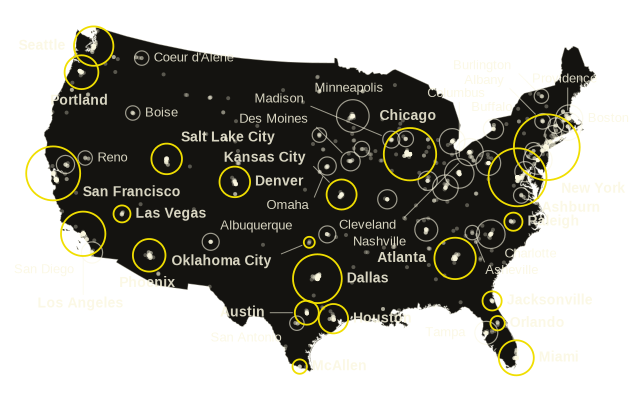
Map: Natural Earth
Cross Connects and Carrier Circuits
Cross Connect in United States
Cross connects and carrier circuits in United States are ordered from the facility operator and the carriers present in the facility. Reboot Monkey places the orders for the customer, and its engineers install and patch the cabling in the customer's rack.
13
of our services in United States
Choose your city

Chicago
- Cross Connects and Carrier Circuits
- Asset Audits and Inventory
- Colocation
- Data Center Decommissioning
- Data Center Migration
- Gpu Ai Cluster Deployment
- Ip Transit
- Rack and Network Design
- Rack and Stack
- Remote Hands
- Server Migration
- Smart Hands
- Structured Cabling

Dallas
- Cross Connects and Carrier Circuits
- Asset Audits and Inventory
- Colocation
- Data Center Decommissioning
- Data Center Migration
- Gpu Ai Cluster Deployment
- Ip Transit
- Rack and Network Design
- Rack and Stack
- Remote Hands
- Server Migration
- Smart Hands
- Structured Cabling

Denver
- Cross Connects and Carrier Circuits
- Asset Audits and Inventory
- Colocation
- Data Center Decommissioning
- Data Center Migration
- Gpu Ai Cluster Deployment
- Ip Transit
- Rack and Network Design
- Rack and Stack
- Remote Hands
- Server Migration
- Smart Hands
- Structured Cabling

Kansas City
- Cross Connects and Carrier Circuits
- Asset Audits and Inventory
- Colocation
- Data Center Decommissioning
- Data Center Migration
- Gpu Ai Cluster Deployment
- Ip Transit
- Rack and Network Design
- Rack and Stack
- Remote Hands
- Server Migration
- Smart Hands
- Structured Cabling

Photo: dconvertini · CC BY-SA 2.0 · source
Los Angeles
- Cross Connects and Carrier Circuits
- Asset Audits and Inventory
- Colocation
- Data Center Decommissioning
- Data Center Migration
- Gpu Ai Cluster Deployment
- Ip Transit
- Rack and Network Design
- Rack and Stack
- Remote Hands
- Server Migration
- Smart Hands
- Structured Cabling

New York
- Cross Connects and Carrier Circuits
- Asset Audits and Inventory
- Colocation
- Data Center Decommissioning
- Data Center Migration
- Gpu Ai Cluster Deployment
- Ip Transit
- Rack and Network Design
- Rack and Stack
- Remote Hands
- Server Migration
- Smart Hands
- Structured Cabling

Photo: Alan Stark from Goodyear, AZ, United States · CC BY-SA 2.0 · source
Phoenix
- Cross Connects and Carrier Circuits
- Asset Audits and Inventory
- Colocation
- Data Center Decommissioning
- Data Center Migration
- Gpu Ai Cluster Deployment
- Ip Transit
- Rack and Network Design
- Rack and Stack
- Remote Hands
- Server Migration
- Smart Hands
- Structured Cabling

San Francisco
- Cross Connects and Carrier Circuits
- Asset Audits and Inventory
- Colocation
- Data Center Decommissioning
- Data Center Migration
- Gpu Ai Cluster Deployment
- Ip Transit
- Rack and Network Design
- Rack and Stack
- Remote Hands
- Server Migration
- Smart Hands
- Structured Cabling
Photo: Vahurzpu · CC BY-SA 4.0 · source
Ashburn
- Cross Connects and Carrier Circuits
- Asset Audits and Inventory
- Colocation
- Data Center Decommissioning
- Data Center Migration
- Ip Transit
- Rack and Network Design
- Rack and Stack
- Remote Hands
- Server Migration
- Smart Hands
- Structured Cabling

Houston
- Cross Connects and Carrier Circuits
- Asset Audits and Inventory
- Colocation
- Data Center Decommissioning
- Gpu Ai Cluster Deployment
- Ip Transit
- Rack and Network Design
- Rack and Stack
- Remote Hands
- Server Migration
- Smart Hands
- Structured Cabling

Miami
- Cross Connects and Carrier Circuits
- Asset Audits and Inventory
- Colocation
- Data Center Decommissioning
- Data Center Migration
- Gpu Ai Cluster Deployment
- Ip Transit
- Rack and Network Design
- Rack and Stack
- Remote Hands
- Server Migration
- Smart Hands
Services in Cross Connects and Carrier Circuits
- Cross Connects and Carrier Circuits
- Colocation
- Data Center Decommissioning
- Data Center Migration
- Gpu Ai Cluster Deployment
- Ip Transit
- Rack and Network Design
- Rack and Stack
- Remote Hands
- Server Migration
- Smart Hands
- Structured Cabling
- ITADon request
In depth
Cross Connects and Carrier Circuits: 7 sections, open any to read more.
Cross Connect in United States: How It Works
Cross connects and carrier circuits in United States are ordered from the facility operator and from the carriers present in the facility. The order comes first. The cabling that reaches your equipment is installed and patched afterwards, in your rack. Reboot Monkey handles both parts of the work: it places the orders, and its engineers do the physical installation and patching. A cross connect and a carrier circuit follow the same request path.
The facility operator owns and runs the building, including its power, cooling and access policy, and Reboot Monkey engineers work under the operator's site rules. For a cross connect, the operator is also one of the parties the order goes to.
A request names a target: a carrier present in the facility, or a circuit from the operator. Naming it at the start lets Reboot Monkey place the order with the right party. Three decisions are worth settling before the request: the facility, the carrier or circuit the connection must reach, and whether the connection is a single link or part of a larger deployment. For a new or expanding deployment, the rack layout and the network topology are settled in rack and network design, which ends with documentation of the design and a controlled handover. A connection needed at several sites is handled as a multi-site rollout: one installation programme carried out at several of the customer's sites by Reboot Monkey engineers.
A request moves through these steps:
- Request: you tell Reboot Monkey the facility, the rack and the carrier or circuit the connection must reach.
- Quote: prices are quoted on request and depend on the customer and the size of the job.
- Order: Reboot Monkey orders the cross connect or carrier circuit from the facility operator and the carriers present in the facility.
- Dispatch: a Reboot Monkey engineer is dispatched to the customer's facility.
- Installation: the engineer installs and patches the cabling in your rack.
Datacenter Landscape in United States
Data centres in United States, ordered by the number of networks present:
- Equinix DC1-DC15,DC21-DC22 - Ashburn (Equinix, Inc.), 21715 Filigree Ct, Building F, Ashburn 20147-6205: 529 networks; carriers ANTEL Internacional, AT&T US, Arelion, EXA Infrastructure, EdgeUno and others
- CoreSite - Los Angeles (LA1) One Wilshire, 624 S. Grand Ave., Los Angeles 90017: 337 networks; carriers Arelion, Falcore Australia Pty Ltd, Global Secure Layer, Huge Networks, Macarne and others
- Equinix CH1/CH2/CH4 - Chicago (Equinix, Inc.), 350 E Cermak Rd, Chicago 60616-1568: 337 networks; carriers AT&T US, Arelion, Global Secure Layer, Hoyos Consulting, Midco and others
- Equinix MI1 - Miami, NOTA (Equinix, Inc.), 50 NE 9th St, Miami 33132-1709: 335 networks; carriers ANTEL Internacional, AT&T US, Arelion, CFH CABLE INC, Cirion and others
- Hurricane Electric Fremont 2, 48233 Warm Springs Blvd, Fremont 94539-7654: 303 networks; carriers AT&T US, CFH CABLE INC and EDGOO NETWORKS
- Equinix SV1/SV5/SV10 - Silicon Valley, San Jose (Equinix, Inc.), 11 Great Oaks Blvd, San Jose 95119-1242: 286 networks; carriers AT&T US, Arelion, Macarne, Orange Wholesale International - EVPL, SG.GS and others
- Digital Realty Seattle SEA10, 2001 Sixth Avenue, Seattle 98121: 234 networks; carriers AT&T US, Arelion, Global Secure Layer, Massive Networks, RETN and others
- CoreSite - Los Angeles (LA2), 900 N. Alameda, Los Angeles 90012: 205 networks; carriers Arelion, Falcore Australia Pty Ltd, Global Secure Layer, Huge Networks, Macarne and others
- Digital Realty ATL13 - Atlanta, 56 Marietta Street, Atlanta 30303: 191 networks; carriers Arelion, Clouvider, DC Blox Dark Fiber, EXA Infrastructure, Global Secure Layer and others
- Equinix DA1 - Dallas (Equinix, Inc.), 1950 N Stemmons Fwy, Dallas 75207-3137: 167 networks; carriers AT&T US, Arelion, FiberLight LLC, Global Secure Layer, Macarne and others
Cross-connects and Carrier Circuits by City
City pages for cross-connects and carrier circuits in United States:
- New York: https://www.rebootmonkey.com/en/united-states/new-york/cross-connects-and-carrier-circuits/
- Ashburn: https://www.rebootmonkey.com/en/united-states/ashburn/cross-connects-and-carrier-circuits/
- Dallas: https://www.rebootmonkey.com/en/united-states/dallas/cross-connects-and-carrier-circuits/
- Chicago: https://www.rebootmonkey.com/en/united-states/chicago/cross-connects-and-carrier-circuits/
- Houston: https://www.rebootmonkey.com/en/united-states/houston/cross-connects-and-carrier-circuits/
- Kansas City: https://www.rebootmonkey.com/en/united-states/kansas-city/cross-connects-and-carrier-circuits/
- Denver: https://www.rebootmonkey.com/en/united-states/denver/cross-connects-and-carrier-circuits/
Cross Connect in United States: What We Deliver
Reboot Monkey sells the network for the rack, and the services around a cross connect follow from that. Each one is a separate request with its own scope, and a single deployment can combine several of them. A request can name one service or several.
Structured cabling is the installing, labelling and patching of the cabling between the customer's racks and network equipment. It applies when a connection has to reach beyond a single patch, such as several racks or several pieces of network equipment, and it is carried out by Reboot Monkey engineers. The request should name the racks and the network equipment the cabling joins.
Rack and stack is installing, mounting and cabling new hardware. It applies when the equipment itself, and not only its connection, has to be placed in the customer's rack. For the equipment, Reboot Monkey also supplies data-centre hardware, servers, network equipment and spare parts, with spares kept in the customer's rack on request. A request names the hardware and the rack it goes into.
GPU and AI cluster deployment covers racking, cabling and node swaps, so the cabling of a cluster is part of the same deployment as its racking. A request names the nodes and the racks involved.
Dark fibre and wavelengths cover dark fibre between data centres and wavelength circuits, ordered from the carriers and quoted on request. A cross connect and a dark fibre link are different orders, so the request should say which one is needed. It also names the data centres to be linked.
IP transit is offered as Economy, Premium and DDoS Premium plans, each quoted per data center for the capacity the customer needs. A quote therefore refers to one data center and the capacity needed there. The request states the plan and the capacity required in each data center.
IPv4 leasing is the leasing of IPv4 addresses, alone or together with IP transit and rack space under one agreement. A customer who needs addresses, transit and a rack in the same data center can request them together with the cross connect.
For network equipment already in the rack, hardware monitoring is the monitoring of the customer's servers and network equipment by the Reboot Monkey NOC. The request lists the servers and network equipment to be monitored.
Stating which service the work belongs to lets Reboot Monkey scope each order before it is placed with the operator or the carriers, and keeps a cross connect order, a dark fibre order and an IP transit quote from being mixed together.
Why Reboot Monkey for Cross Connect in United States
A buyer with equipment in several places needs a supplier whose engineers work where the equipment is. As of 2026, Reboot Monkey's field engineers work in 190 countries and more than 400 locations. The figure describes the company as a whole, not any single city or country.
A second, briefed Reboot Monkey engineer is named as backup for every customer site. The backup is named for the site, not for a single task, so it applies to the site where a cross connect is installed in the same way as to every other customer site.
Recurring work is covered by remote hands retainers and hour blocks: remote hands agreed as a retainer or as a block of hours for recurring work, with terms agreed per customer and quoted on request. Terms are set per customer, so two customers can hold different retainers. A customer who expects regular cable checks can agree those terms in advance. The request should state which kind of work recurs and how often.
Asset inventory work records the customer's equipment in the data center by serial number, asset tag and rack position, against the customer's asset list. The record shows where each item actually sits. The same record can be taken before and after a move, so the two lists can be compared. The request should name the racks to be recorded and supply the asset list.
Server migration is the moving of equipment between racks, rooms or facilities. Moving between racks or rooms inside one facility is migration too, and it does not need a change of facility. Datacenter exit and relocation is the physical move of the customer's equipment to its new location together with the removal and disposal of the hardware that is retired. When equipment moves to a different facility, the connections at the destination are a new order, placed in the same way. The request should name the origin, the destination and the hardware that moves or is retired.
IT infrastructure turnkey and run is a different arrangement: you or your investors fund the IT infrastructure. Reboot Monkey buys, installs, configures and then runs it for you, inside the data center you choose. The request should name the data center and the infrastructure to be funded and run.
Which service fits depends on the job. A new link into an existing rack is a cross connect or carrier circuit request. New equipment is rack and stack. Equipment changing facility is server migration or exit and relocation. Recurring physical support is a retainer. Each of these is a separate request, and several can be placed together.
How Reboot Monkey Works
These terms apply in every facility in United States where Reboot Monkey engineers work.
- Scope: Reboot Monkey orders cross connects and carrier circuits from the facility operator and the carriers present in the facility, and its engineers install and patch the cabling in the customer's rack.
- Response: 1-hour, around-the-clock incident response SLA, and a 15 minute premium response available where technicians are stationed on-site, as a paid add-on. The incident response SLA covers incidents and unplanned requests; on-site, dispatch and resolution times, priority tiers, and planned or scheduled work are agreed per site in the service agreement.
- Monitoring: 24/7 NOC monitoring across all facilities, covering IPMI, iDRAC, SNMP, temperature, power, network signals.
- Hardware: vendor-neutral technicians for Dell, HP, Cisco, Juniper and Arista equipment.
- Independence: independent from facility operators (not Equinix SmartHands, not NTT staff).
- One agreement: single provider across cities, so a customer in several cities needs only one agreement.
- Service levels and terms: https://www.rebootmonkey.com/en/solutions/sla
- Published case study: a major ICT provider engaged Reboot Monkey for three full infrastructure rollouts in Lahore, Karachi and Islamabad, with the hardware installed the same day at every site. Read the case study at https://www.rebootmonkey.com/en/resources/case-study/how-we-completed-3-full-deployments-across-pakistan
Cross Connects and Carrier Circuits
The data centres we work in hold their own certifications, such as ISO/IEC 27001 and ISO 9001. Ask us for the certificate of your site.
Frequently Asked Questions
What does cross-connects and carrier circuits cover in United States?
It covers two things. First, the order: Reboot Monkey orders cross connects and carrier circuits from the facility operator and the carriers present in the facility. Second, the physical work: its engineers install and patch the cabling in the customer's rack. Dark fibre between data centres and wavelength circuits are a separate order, placed with the carriers and quoted on request.
Do you work in every datacenter in United States?
Reboot Monkey engineers work in any facility in United States where the customer has equipment and access, under the operator's own access and safety rules. The customer adds the engineers to the facility's access list before the first visit.
How fast can Reboot Monkey respond in United States?
Incidents and unplanned requests are handled under a 1-hour, around-the-clock incident response SLA. There is also a 15 minute premium response available where technicians are stationed on-site, as a paid add-on. On-site, dispatch and resolution times, priority tiers, and planned or scheduled work are agreed per site in the service agreement.
How is Reboot Monkey different from the facility operator's own staff?
Facility operators' own technicians work for the building. Reboot Monkey engineers work for the customer: they are independent from facility operators (not Equinix SmartHands, not NTT staff), follow the customer's instructions, and the same team can cover several buildings in the country under one agreement.
How do I get started with cross-connects and carrier circuits in United States?
Send the site, the equipment and the task through the contact form. Reboot Monkey replies with a quote and an engineer plan for that facility. Once agreed, the customer adds the engineers to the facility's access list and the cross-connects and carrier circuits work is scheduled under the operator's rules.
Cities we cover in United States
Request a Cross Connect in United States
Tell Reboot Monkey the facility, the rack and the carrier or circuit the connection must reach, and receive a quote.