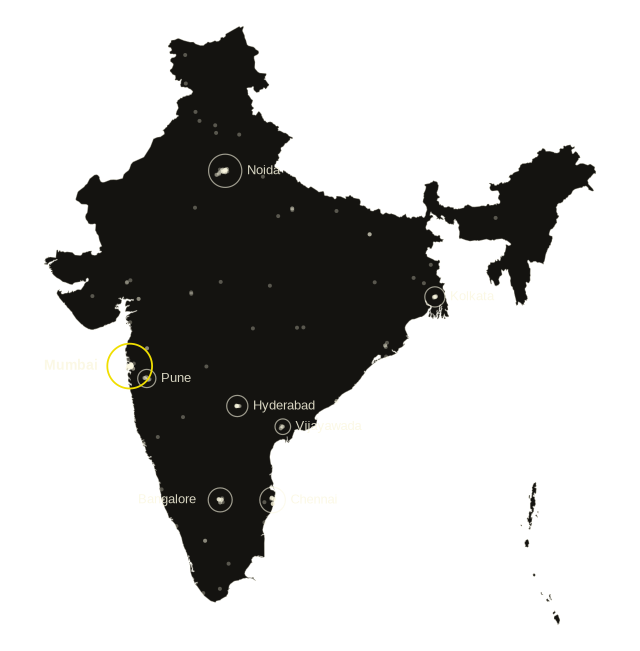
Map: Natural Earth
Structured Cabling
Structured Cabling in India
Structured cabling in India is the installing, labelling and patching of the cabling between a customer's racks and network equipment. Reboot Monkey engineers carry it out inside data centres that other companies own and run, and each job is quoted on request.
15
of our services in India
In depth
Structured Cabling: 9 sections, open any to read more.
Structured Cabling in India: How It Works
Structured cabling in India starts with a plain question: what has to be connected to what, rack by rack. Reboot Monkey defines the work as installing, labelling and patching the cabling between the customer's racks and network equipment. It is delivered inside data centres that other companies own and run, because Reboot Monkey is a third-party datacenter services operator, not a hosting company and not a datacenter owner.
A request follows a fixed order. The customer describes the job: which racks are involved, which network equipment sits in them and which connections are needed. Reboot Monkey confirms the scope against that description and quotes the work. Prices are quoted on request and depend on the customer and the size of the job. Once the quote is accepted, a Reboot Monkey engineer is dispatched to the customer's facility in India to install, label and patch the cabling.
Before dispatch, a few points are settled with the customer. These are the data center where the racks stand, the racks and equipment to be connected, and whether the cabling is a job on its own or one line in a larger deployment, for example new hardware that is being racked at the same visit. Settling them first keeps the quote tied to the work as the customer describes it, and keeps the engineer's task list short and specific.
Datacenter Landscape in India
Data centres in India, ordered by the number of networks present:
- Equinix MB1 - Mumbai (GPX Mumbai 1) (Equinix, Inc.), Unit A-001, Boomerang Chandivali Farm Road, Near Chandivali Studio, Andheri East Mumbai, 400 051: 262 networks; carriers Netlayer Global Fabric, Reliance Jio and i3D.net
- Web Werks Mumbai 1 (Web Werks DataCenter Pvt. Ltd.), Sigma IT Park, Rabale MIDC, Mumbai 400701: 194 networks; carriers Nextremum
- Sify Greenfort - Noida (Sify Technologies Limited), B7, Block A, Sector 132, Noida Expressway, 201304: 149 networks
- Bharti Airtel Santhome (Bharti Airtel Limited), Bharti Towers, 101 Santhome High Road, Chennai 600 028: 90 networks
- TATA Communications Mumbai (TATA Communications Ltd), Kashinath Dhuru Marg, Prabahdevi, Mumbai 400 028: 86 networks; carriers Reliance Jio
- TATA Communications Chennai (TATA Communications Ltd), 4th floor, 2nd block, Chennai 600 002: 81 networks; carriers Netlayer Global Fabric and Reliance Jio
- TATA Communications Delhi (TATA Communications Ltd), VSB, Bangla Sahib Road, New Delhi 110001: 73 networks; carriers Reliance Jio
- TATA Communications GK1 (TATA Communications Ltd), VSNL Colony, Greater Kailash I, New Delhi 110048: 64 networks; carriers Netlayer Global Fabric and Reliance Jio
- CtrlS Hyderabad DC1 (CtrlS Datacenters Ltd), #16, Software Units Layout, Madhapur (Hitech-City), Hyderabad 500081: 62 networks; carriers CtrlS Connect, Reliance Jio and Vodafone Idea
- CtrlS Mumbai DC1 (CtrlS Datacenters Ltd), Plot No. GEN 72/1/A, TTC Industrial Area, South Central Road, MIDC Industrial Area, Mahape, Mumbai 400710: 61 networks; carriers CtrlS Connect, Netlayer Global Fabric, Reliance Jio and Vodafone Idea
Structured Cabling in India: What We Deliver
Cabling is rarely the only physical task in a deployment, so it is scoped next to the services that most often sit beside it in a rack. Each service below keeps the definition Reboot Monkey uses for it.
- Structured cabling: installing, labelling and patching the cabling between the customer's racks and network equipment.
- Rack and stack: installing, mounting and cabling new hardware.
- Rack and network design: the rack layout and the network topology of a new or expanding deployment, ending with documentation of the design and a controlled handover.
- Cross-connects and carrier circuits: ordered from the facility operator and the carriers present in the facility, with Reboot Monkey engineers installing and patching the cabling in the customer's rack.
- GPU and AI cluster deployment: racking, cabling and node swaps.
- Multi-site rollouts: one installation programme carried out at several of the customer's sites by Reboot Monkey engineers.
- Asset inventory: recording the customer's equipment in the data center by serial number, asset tag and rack position, against the customer's asset list.
- Remote hands: physical tasks carried out on the customer's instruction, such as reboots, cable checks, component swaps and visual checks.
Basics of Structured Cabling in India
Structured cabling replaces ad hoc cable runs with an organised, labelled connection plan between racks and the network equipment inside them. Reboot Monkey's scope for this work has three parts, and each is a physical task carried out by its engineers in the customer's racks.
Installing is the placement of the cabling between the customer's racks and network equipment. Labelling gives each cable an identity that can be read in the rack, so anyone working there later can tell which connection they are looking at. Patching is the making of the connections between that cabling and the customer's network equipment. Patching is also the part that changes most often, because equipment is added, moved and replaced over the life of a deployment, while the installed cabling and its labels stay in place as the reference.
Labelling matters most after the first installation, because later work refers back to it. A cable check under remote hands, a move of equipment under server migration (moving equipment between racks, rooms or facilities) and the removal of retired hardware under data center decommissioning all begin with identifying which cable goes where. A rack that was cabled and labelled at the start gives each of those tasks a reference point.
A request for structured cabling in India is therefore written around the customer's racks, not around a product list. The customer names the racks and the equipment, and Reboot Monkey engineers are dispatched to the data center the customer has chosen.
Components of Structured Cabling in India
A structured cabling job involves four kinds of component, and Reboot Monkey's role differs for each. The first is the customer's racks. The second is the customer's network equipment mounted in them. The third is the cabling between the two, which Reboot Monkey engineers install, label and patch. The fourth is anything that arrives from outside the rack, such as carrier circuits and, for links between data centres, dark fibre and wavelengths.
Those outside components take a different route from the cabling inside the rack. Dark fibre between data centres and wavelength circuits are ordered from the carriers and quoted on request. The cabling that reaches the customer's rack from any of them is installed and patched by Reboot Monkey engineers, so the last metre of every connection is handled by the same people who cabled the rest of the rack.
Fibre links add one further concern, which is the condition of the connectors. A fibre inspection scope and cleaning kit are available on request, so fibre connections can be inspected and cleaned during the job instead of being left for a later visit.
Hardware belongs to the same picture. Reboot Monkey supplies data-centre hardware, servers, network equipment and spare parts, and spares can be kept in the customer's rack on request. A customer who needs new network equipment and the cabling to connect it can describe both in one request, and the scope is written to cover the equipment and the cabling together.
Essential Elements of Structured Cabling
Five elements decide whether a cabling job stays usable after the engineer has left the building. Each one maps to something Reboot Monkey does as part of the work.
- Planning: for a new or expanding deployment, rack and network design fixes the rack layout and the network topology before cabling begins and ends with documentation of the design and a controlled handover.
- Labelling: every cable installed is labelled, so the connection can be identified in the rack by anyone who works there afterwards.
- Site rules: the facility operator owns and runs the building, including its power, cooling and access policy, and Reboot Monkey engineers work under the operator's site rules.
- Continuity: a second, briefed Reboot Monkey engineer is named as backup for every customer site.
- Tools: a fibre inspection scope and cleaning kit are available on request for jobs that include fibre.
Why Reboot Monkey for Structured Cabling in India
Structured cabling is one part of a rack deployment, and Reboot Monkey covers the other parts as well. It sells rack space, IP transit, leased IP addresses, network and data-centre hardware, together with the services that deliver, install and support them. A customer can therefore place the cabling in the same request as the rest of the rack.
On the network side, IP transit is offered as Economy, Premium and DDoS Premium plans, each quoted per data center for the capacity the customer needs. IPv4 addresses can be leased alone or together with IP transit and rack space.
For customers who prefer not to buy and run the equipment themselves, there is a turnkey option: you or your investors fund the IT infrastructure. Reboot Monkey buys, installs, configures and then runs it for you, inside the data center you choose. Cabling is part of the installation in that model.
As of 2026, Reboot Monkey's field engineers work in 190 countries and more than 400 locations. For a customer whose racks are in India and elsewhere, that coverage lets cabling work in several places be requested in the same way.
How Reboot Monkey Works
These terms apply in every facility in India where Reboot Monkey engineers work.
- Scope: Structured cabling work covers installing, labelling and patching the cabling between the customer's racks and network equipment; quotes are on request.
- Response: 1-hour, around-the-clock incident response SLA, and a 15 minute premium response available where technicians are stationed on-site, as a paid add-on. The incident response SLA covers incidents and unplanned requests; on-site, dispatch and resolution times, priority tiers, and planned or scheduled work are agreed per site in the service agreement.
- Monitoring: 24/7 NOC monitoring across all facilities, covering IPMI, iDRAC, SNMP, temperature, power, network signals.
- Hardware: vendor-neutral technicians for Dell, HP, Cisco, Juniper and Arista equipment.
- Independence: independent from facility operators (not Equinix SmartHands, not NTT staff).
- One agreement: single provider across cities, so a customer in several cities needs only one agreement.
- Service levels and terms: https://www.rebootmonkey.com/en/solutions/sla
- Published case study: a major ICT provider engaged Reboot Monkey for three full infrastructure rollouts in Lahore, Karachi and Islamabad, with the hardware installed the same day at every site. Read the case study at https://www.rebootmonkey.com/en/resources/case-study/how-we-completed-3-full-deployments-across-pakistan
Structured Cabling
The data centres we work in hold their own certifications, such as ISO/IEC 27001 and ISO 9001. Ask us for the certificate of your site.
Frequently Asked Questions
What does structured cabling cover in India?
In India, structured cabling covers installing, labelling and patching the cabling between the customer's racks and network equipment. Reboot Monkey engineers carry out the work inside the customer's data center, and quotes are on request. Cross-connects and carrier circuits are ordered from the facility operator and the carriers present in the facility, with the cabling installed and patched in the customer's rack.
Do you work in every datacenter in India?
Reboot Monkey engineers work in any facility in India where the customer has equipment and access, under the operator's own access and safety rules. The customer adds the engineers to the facility's access list before the first visit.
How fast can Reboot Monkey respond in India?
Incidents and unplanned requests are handled under a 1-hour, around-the-clock incident response SLA. There is also a 15 minute premium response available where technicians are stationed on-site, as a paid add-on. On-site, dispatch and resolution times, priority tiers, and planned or scheduled work are agreed per site in the service agreement.
How is Reboot Monkey different from the facility operator's own staff?
Facility operators' own technicians work for the building. Reboot Monkey engineers work for the customer: they are independent from facility operators (not Equinix SmartHands, not NTT staff), follow the customer's instructions, and the same team can cover several buildings in the country under one agreement.
How do I get started with structured cabling in India?
Send the site, the equipment and the task through the contact form. Reboot Monkey replies with a quote and an engineer plan for that facility. Once agreed, the customer adds the engineers to the facility's access list and the structured cabling work is scheduled under the operator's rules.
Request a Structured Cabling Quote
Describe the racks and the equipment to be connected, and Reboot Monkey will quote the job.