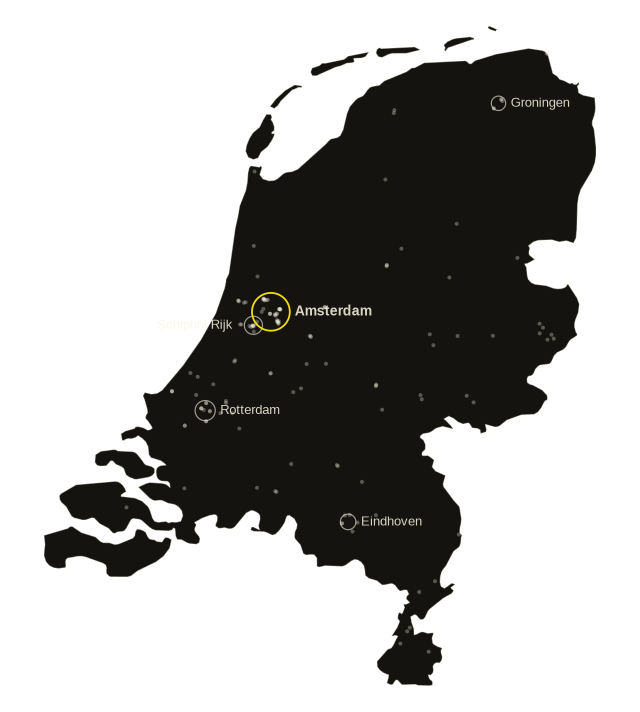
Map: Natural Earth
Asset Audits and Inventory
Hardware Inventory in Netherlands
Hardware inventory in Netherlands means recording the customer's equipment in the data centre by serial number, asset tag and rack position, against the customer's asset list. Reboot Monkey engineers are dispatched to the customer's facility to carry out the work at the rack.
13
of our services in Netherlands
Choose your city

Photo: Basile Morin · CC BY-SA 4.0 · source
Amsterdam
- Asset Audits and Inventory
- Colocation
- Cross Connects and Carrier Circuits
- Data Center Decommissioning
- Data Center Migration
- Gpu Ai Cluster Deployment
- Ip Transit
- Rack and Network Design
- Rack and Stack
- Remote Hands
- Server Migration
- Smart Hands
- Structured Cabling
Services in Asset Audits and Inventory
In depth
Asset Audits and Inventory: 6 sections, open any to read more.
Hardware Inventory in Netherlands: How It Works
A hardware inventory in a data centre settles one question: which equipment is installed in which rack, and whether that agrees with what the business believes it owns. For a CTO, IT director or procurement manager responsible for equipment in Netherlands, the answer rests on three identifiers for each device: the serial number, the asset tag and the rack position. An asset audit records the customer's equipment in the data centre: serial numbers, asset tags and rack positions, against the customer's asset list.
Each identifier does a different job. The serial number identifies the unit itself and stays with it through its life. The asset tag is the customer's own label and ties the unit to a line in the asset list. The rack position says where the unit is installed, so that anyone who needs to find it, move it or remove it can go to the right place. Recorded together, these identifiers allow a line in the list to be linked to a physical device.
The work is done at the rack. Purchase records show what was ordered, and a network view shows what answers on the network, but neither shows what is physically installed and where. A device that was moved, replaced or retired without an update to the list can appear in the list and not in the rack, or in the rack and not in the list. Reading the identifiers on the equipment itself is how that difference becomes visible.
A request follows this sequence:
- Scope. The customer names the data centre in Netherlands, the racks or rooms to be covered, and supplies the asset list the record will be set against.
- Dispatch. A Reboot Monkey engineer is dispatched to the customer's facility, with a second, briefed Reboot Monkey engineer named as backup for the customer site.
- Recording. For each device in scope the engineer records the serial number, the asset tag and the rack position.
- Comparison. Every recorded line is set against the customer's asset list.
- Handover. The customer holds the record of serial numbers, asset tags and rack positions for the equipment in the data centre, laid out against its own list.
Datacenter Landscape in Netherlands
Data centres in Netherlands, ordered by the number of networks present:
- NIKHEF Amsterdam, Science Park 105, 1098 XG Amsterdam: 509 networks; carriers 1-IX EU, 31173 Services, Afiber, Arelion, Aristo Networks and others
- Equinix AM7 - Amsterdam, Kuiperberweg (Equinix, Inc.), Kuiperbergweg 13, 1101 AE Amsterdam: 220 networks; carriers 3W Infra B.V., Arcadiz, Arelion, Aristo Networks, Asimo Networks BV and others
- Equinix AM5 - Amsterdam, Schepenbergweg (Equinix, Inc.), Schepenbergweg 42, 1105 AT Amsterdam: 181 networks; carriers 1-IX EU, 3W Infra B.V., Arelion, Aristo Networks, Asimo Networks BV and others
- Iron Mountain Data Center - Amsterdam (AMS-1) (Iron Mountain Data Centers), J.W. Lucasweg 35, 2031 BE Amsterdam: 176 networks; carriers 3W Infra B.V., Afiber, Arelion, Aristo Networks, Asimo Networks BV and others
- Digital Realty AMS17 - Amsterdam, Science Park 120, 1098 XG Amsterdam: 153 networks; carriers Arcadiz, Arelion, Backbone.direct, Clouvider, Eranium Fabric and others
- Digital Realty AMS9 - Amsterdam, Science Park 121, 1098 XG Amsterdam: 152 networks; carriers Afiber, Arcadiz, Arelion, BIT BV, Backbone.direct and others
- Equinix AM1/AM2 - Amsterdam, Luttenbergweg (Equinix, Inc.), Luttenbergweg 4, 1101 EC Amsterdam: 146 networks; carriers 3W Infra B.V., Afiber, Arelion, Aristo Networks, Asimo Networks BV and others
- Equinix AM3 - Amsterdam, Science Park (Equinix, Inc.), Science Park 610, 1098 XH Amsterdam: 131 networks; carriers Afiber, Arelion, Aristo Networks, Asimo Networks BV, Core-Backbone and others
- Digital Realty AMS3/5/7/8/10 - Amsterdam, Cessnalaan 1, 1119 NJ Amsterdam: 121 networks; carriers Afiber, Arcadiz, Arelion, Eranium Fabric, Eurofiber and others
- Global Switch Amsterdam, Johan Huizingalaan 759, 1066 VH Amsterdam: 99 networks; carriers Arelion, Aristo Networks, Asimo Networks BV, Backbone.direct, Eurofiber and others
Hardware Inventory in Netherlands: What We Deliver
The deliverable of an asset audit is a record. For every device in scope it holds the serial number, the asset tag and the rack position. The record is set against the customer's asset list, so the customer can see, line by line, where the list and the data centre agree. The asset list is the customer's own document, whether it comes from the finance, procurement or IT team, and Reboot Monkey works from the list the customer provides.
The scope of the record is as follows:
An asset audit covers equipment physically installed in the data centre where the Reboot Monkey engineer is working. It is a physical record, taken at the rack. It does not replace the monitoring of the customer's servers and network equipment, which Reboot Monkey offers as a separate service run by its NOC, and it does not change anything in the racks: moving, adding or removing equipment is separate work agreed with the customer.
A current record is the usual starting point for the physical work that follows, and Reboot Monkey carries out that work as well:
- Server migration moves equipment between racks, rooms or facilities. A record of serial numbers and rack positions shows which devices are in scope before the move starts.
- Data center decommissioning removes and disposes of retired hardware. The asset list names what is retired, and the record shows where those devices stand.
- IT asset disposition covers retired hardware that leaves the rack, with collection and transport, and resale or buyback quoted case by case.
- Rack and stack installs, mounts and cables new hardware, which then needs its own line in the asset list.
- Structured cabling installs, labels and patches the cabling between the customer's racks and network equipment.
- Hardware supply and spares provides data-centre hardware, servers, network equipment and spare parts, with spares kept in the customer's rack on request.
Why Reboot Monkey for Hardware Inventory in Netherlands
Reboot Monkey is a third-party datacenter services operator. It sells rack space, IP transit, leased IP addresses, network, data-centre hardware and the services that deliver, install and support them. It is not a hosting company and it does not own data centres. For a customer in Netherlands this means the record of what stands in the rack comes from the same company that can install, move, cable and retire that equipment.
The physical work around the record sits with Reboot Monkey engineers. Reboot Monkey orders cross connects and carrier circuits from the facility operator and the carriers present in the facility, and its engineers install and patch the cabling in the customer's rack. Where a customer runs equipment at several sites, multi-site rollouts are one installation programme carried out at those sites by Reboot Monkey engineers, under one agreement.
When a recording turns up a device that needs attention, the follow-up options are defined in plain terms. Remote hands carries out physical tasks on the customer's instruction: reboots, cable checks, component swaps and visual checks. Smart hands is technical work that needs diagnostic judgement and configuration knowledge. For recurring work, remote hands can be agreed as a retainer or as a block of hours, with terms agreed per customer and quoted on request.
Customers whose inventory leads to a new deployment can also order the following from Reboot Monkey:
IP transit is offered as Economy, Premium and DDoS Premium plans, each quoted per data center for the capacity the customer needs. IPv4 leasing covers IPv4 addresses, alone or together with IP transit and rack space under one agreement. GPU and AI cluster deployment covers racking, cabling and node swaps. In the IT infrastructure turnkey and run service, the customer or its investors fund the infrastructure, and Reboot Monkey buys, installs, configures and then runs it, inside the data center the customer chooses. The data center itself stays with its operator.
As of 2026, Reboot Monkey's field engineers work in 190 countries and more than 400 locations.
How Reboot Monkey Works
These terms apply in every facility in Netherlands where Reboot Monkey engineers work.
- Scope: An asset audit records the customer's equipment in the data centre: serial numbers, asset tags and rack positions, against the customer's asset list.
- Response: 1-hour, around-the-clock incident response SLA, and a 15 minute premium response available where technicians are stationed on-site, as a paid add-on. The incident response SLA covers incidents and unplanned requests; on-site, dispatch and resolution times, priority tiers, and planned or scheduled work are agreed per site in the service agreement.
- Monitoring: 24/7 NOC monitoring across all facilities, covering IPMI, iDRAC, SNMP, temperature, power, network signals.
- Hardware: vendor-neutral technicians for Dell, HP, Cisco, Juniper and Arista equipment.
- Independence: independent from facility operators (not Equinix SmartHands, not NTT staff).
- One agreement: single provider across cities, so a customer in several cities needs only one agreement.
- Service levels and terms: https://www.rebootmonkey.com/en/solutions/sla
- Published case study: a major ICT provider engaged Reboot Monkey for three full infrastructure rollouts in Lahore, Karachi and Islamabad, with the hardware installed the same day at every site. Read the case study at https://www.rebootmonkey.com/en/resources/case-study/how-we-completed-3-full-deployments-across-pakistan
Asset Audits and Inventory
The data centres we work in hold their own certifications, such as ISO/IEC 27001 and ISO 9001. Ask us for the certificate of your site.
Frequently Asked Questions
What Is Hardware Inventory Management?
Hardware inventory management is the practice of keeping an accurate record of the physical equipment an organisation owns and where each device is. In a data centre, Reboot Monkey carries out the physical part: it records the customer's equipment by serial number, asset tag and rack position and sets that record against the customer's asset list.
What does asset audits and inventory cover in Netherlands?
In Netherlands, an asset audit records the customer's equipment in the data centre: serial numbers, asset tags and rack positions, against the customer's asset list. A Reboot Monkey engineer is dispatched to the customer's facility to do the work at the rack. Prices are quoted on request and depend on the customer and the size of the job.
Do you work in every datacenter in Netherlands?
Reboot Monkey engineers work in any facility in Netherlands where the customer has equipment and access, under the operator's own access and safety rules. The customer adds the engineers to the facility's access list before the first visit.
How fast can Reboot Monkey respond in Netherlands?
Incidents and unplanned requests are handled under a 1-hour, around-the-clock incident response SLA. There is also a 15 minute premium response available where technicians are stationed on-site, as a paid add-on. On-site, dispatch and resolution times, priority tiers, and planned or scheduled work are agreed per site in the service agreement.
How is Reboot Monkey different from the facility operator's own staff?
Facility operators' own technicians work for the building. Reboot Monkey engineers work for the customer: they are independent from facility operators (not Equinix SmartHands, not NTT staff), follow the customer's instructions, and the same team can cover several buildings in the country under one agreement.
How do I get started with asset audits and inventory in Netherlands?
Send the site, the equipment and the task through the contact form. Reboot Monkey replies with a quote and an engineer plan for that facility. Once agreed, the customer adds the engineers to the facility's access list and the asset audits and inventory work is scheduled under the operator's rules.
Cities we cover in Netherlands
Request an Asset Audit in Netherlands
Send Reboot Monkey the asset list and the data centre that holds the equipment, and the request is scoped from there.