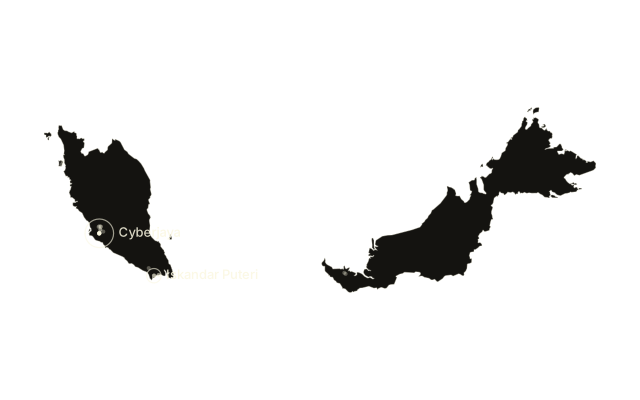
Map: Natural Earth
Server Migration
Server Migration in Malaysia
Server migration in Malaysia is the physical move of equipment between racks, rooms or facilities, carried out by Reboot Monkey engineers dispatched to the customer's facility. Reboot Monkey can run the whole move or work alongside the customer's own team, and the split is agreed per project.
9
of our services in Malaysia
Choose your city
Services in Server Migration
In depth
Server Migration: 7 sections, open any to read more.
Server Migration in Malaysia: How It Works
Server migration is moving equipment between racks, rooms or facilities. For a project in Malaysia, the work starts with a request that states what has to move, where it sits today and where it has to go. Reboot Monkey engineers are dispatched to the customer's facility to carry out the physical work, and the details are agreed with the customer for each project.
A migration takes place inside a building that Reboot Monkey does not run. The facility operator owns and runs the building, including its power, cooling and access policy, and Reboot Monkey engineers work under the operator's site rules. Access arrangements for the move are therefore part of the plan from the first request, next to the equipment list.
The three kinds of move differ in scope. A move between racks or between rooms stays inside one building. A move between facilities involves two buildings, so access has to be arranged at both ends and the equipment has to travel between them. Who handles that leg is part of what is agreed for the project.
Equipment is the operative word. A project can include servers and the network equipment that goes with them, and listing both lets the destination rack be planned for the whole set.
The request then runs in order. The customer submits it, and the scope and the split of work are agreed. Reboot Monkey engineers are dispatched to the customer's facility. The equipment is disconnected, moved and reconnected, the cabling is patched, and the party agreed for the testing step tests it before the project is closed. The testing step closes the physical work; what follows, such as monitoring, is ordered as a service of its own.
Network at the destination belongs in the same request. Reboot Monkey sells the network for the rack: it orders the cross connects and carrier circuits from the facility operator and the carriers present in the facility, and Reboot Monkey engineers install and patch the cabling in the customer's rack. Listing the circuits needed at the destination lets those orders be placed alongside the move.
Related work can attach to the same request: installing new hardware at the destination, removing retired hardware at the source, or support after the move. Each is a separate service with its own scope. Which of them apply is decided when the request is scoped.
Whatever the split of work, a complete request for a migration lists:
- The servers and network equipment to be moved, with the rack, room or facility each one stands in today
- The destination rack, room or facility
- The network needed at the destination, including any cross connects and carrier circuits
- Any new hardware to be installed at the destination
- Any retired hardware to be removed at the source
- The steps the customer's own team will take, if any
- Timing constraints and any access arrangements for the site
Datacenter Landscape in Malaysia
Data centres in Malaysia, ordered by the number of networks present:
- AIMS Kuala Lumpur (AIMS Data Centre Sdn Bhd), Ground Floor, Menara AIMS, Changkat Raja Chulan, Kuala Lumpur 50200: 103 networks; carriers SG.GS
- CSF CX1 / TelcoHub1 Kuala Lumpur (CSF Group), CSF Building, Computer Exchange 1, Jalan Teknokrat 6, Cyberjaya 63000: 35 networks; carriers SG.GS
- CX2 / MY01 Cyberjaya Malaysia (Bridge Data Centres), MY02, 7118 Jalan Impact, Cyberjaya 63000: 28 networks; carriers SG.GS
- CJ1 CYBERJAYA (Mytelehaus), No.1, Jalan Cyber Point 4, Cyber 8, Cyberjaya 63000: 24 networks; carriers SG.GS
- Equinix JH1 - Johor (Equinix, Inc.), No.2 & 6, Jalan Teknologi Perintis, 1/3, Taman Teknologi, Nusajaya, Iskandar Puteri 79200: 18 networks; carriers SG.GS
- NTT Cyberjaya Data Center (CBJ) (NTT DATA's Global Data Centers division), 43000 Jalan APEC, Cyberjaya, Selangor Darul Ehsan, 63000: 15 networks; carriers SG.GS
- Open DC JB1 - Menara MSC Cyberport (OPEN DC SDN BHD), Level 16, Menara MSC Cyberport, 5, Jalan Bukit Meldrum, Tanjung Puteri, Johor Bahru 80300: 15 networks
- TM ONE KVDC, Cyberjaya (Telekom Malaysia Berhad (TM)), Lingkaran Teknokrat Timur, Cyberjaya 63000: 14 networks; carriers SG.GS
- AIMS Cyberjaya (AIMS Data Centre Sdn Bhd), Jalan Teknokrat 1/2, Cyber 3, Cyberjaya 63000: 10 networks; carriers SG.GS
- AIMS CJ1 Cyberjaya (AIMS Data Centre Sdn Bhd), Jalan Cyber Point 4, Cyber 8, Cyberjaya 63000: 7 networks; carriers SG.GS
Server Migration by City
City pages for server migration in Malaysia:
- Cyberjaya: https://www.rebootmonkey.com/en/malaysia/cyberjaya/server-migration/
Server Migration in Malaysia: What We Deliver
A server migration is the core of the request, and the services around it attach to it when the project needs them. Each related service keeps its own definition and can be added to a migration request.
Rack space, IP transit, leased IP addresses and network are part of what Reboot Monkey sells, so a move into a new rack can include the capacity itself and not only the work of moving into it. A customer that already holds space at the destination can request the move alone.
The related services are:
The difference between remote hands and smart hands is the judgement involved. A remote hands task is carried out on the customer's instruction, so the customer decides what is done and the Reboot Monkey engineer does it. A smart hands task needs the engineer to bring diagnostic judgement and configuration knowledge. When a request mixes both kinds, it can separate them task by task.
Decommissioning and ITAD apply to hardware that is retired rather than moved. A project that moves some servers and retires others can carry both in one request, with the retired hardware handled as decommissioning and, where data or asset value is involved, as ITAD. Which equipment falls into which group is stated in the request.
Hardware monitoring is carried out by the Reboot Monkey NOC, not by the engineers on site, so it is a separate piece of work from the move. Adding it to a migration request means the NOC monitors the servers and network equipment from their new location onward.
The engineers dispatched to the customer's facility carry out the physical services among these (the move, rack and stack, remote hands and smart hands), while the data handling in ITAD takes place on the customer's site or in a partner's processing facility.
- Rack and stack: installing, mounting and cabling new hardware. It applies when the destination receives new hardware in addition to the moved servers.
- Remote hands: physical tasks carried out on the customer's instruction (reboots, cable checks, component swaps, visual checks). It applies to physical tasks that follow the move.
- Smart hands: technical work that needs diagnostic judgement and configuration knowledge. It applies when a task after the move needs an engineer to diagnose a fault or to configure equipment.
- Data center decommissioning: removing and disposing of retired hardware. It applies to equipment that is not moved and is retired at the source.
- IT asset disposition (ITAD): data wiping, on-site shredding or degaussing, collection and transport, and resale or buyback quoted case by case, all processed by Reboot Monkey staff in a partner's processing facility or on the customer's site.
- Hardware monitoring: monitoring of the customer's servers and network equipment by the Reboot Monkey NOC. It applies to the equipment once it stands in its new location.
Why Reboot Monkey for Server Migration in Malaysia
Reboot Monkey is a third-party datacenter services operator. It is not a hosting company and it does not own datacenters. A server migration with Reboot Monkey is therefore a physical service performed on the customer's own equipment, not a move onto a hosted platform. The servers that are moved are the customer's, and so are the decisions about what runs on them.
As of 2026, Reboot Monkey's field engineers work in 190 countries and more than 400 locations. Field engineers are the people dispatched to a customer's facility to carry out the physical work, and the figure describes the company as a whole rather than any one country.
A second, briefed Reboot Monkey engineer is named as backup for every customer site. Every customer site therefore has two named engineers, the one dispatched to the work and the backup.
A request is easier to scope when the customer's contact can answer, for each item to be moved, where it stands today, where it is going and who handles each step.
Reboot Monkey can run the whole physical move or work alongside the customer's own team. Who disconnects, reconnects and tests the equipment is agreed per project, so the customer decides how much of the move to hand over. A team that wants to keep the disconnecting and testing steps can keep them, and a team that wants the whole physical move handled can ask for that. Each project settles who takes three steps: disconnecting the equipment at the source rack, room or facility, reconnecting it in the destination rack with its cabling, and testing it at the destination. Any of the three can sit with the customer's team or with Reboot Monkey engineers.
For the person who owns the equipment, three points decide whether a migration request is ready: the split of work between Reboot Monkey engineers and the customer's own team, the network needed at the destination, and the related services that attach to the move, such as rack and stack or decommissioning. Each is a line in the request and can change from one project to the next.
For procurement, the points are the scope a quote refers to, the engineers named for the site, and the basis of the quote itself. A quote tied to a defined scope can be checked against what was delivered. Prices are quoted on request and depend on the customer and the size of the job.
The size of the job is set by what the request describes: how much equipment moves, how many locations are involved, whether new hardware is installed or retired hardware removed, and how much of the physical work stays with the customer's own team. A move between two racks in one room and a move between two facilities are different jobs, and they are quoted as different jobs.
How Reboot Monkey Works
These terms apply in every facility in Malaysia where Reboot Monkey engineers work.
- Response: 1-hour, around-the-clock incident response SLA, and a 15 minute premium response available where technicians are stationed on-site, as a paid add-on. The incident response SLA covers incidents and unplanned requests; on-site, dispatch and resolution times, priority tiers, and planned or scheduled work are agreed per site in the service agreement.
- Monitoring: 24/7 NOC monitoring across all facilities, covering IPMI, iDRAC, SNMP, temperature, power, network signals.
- Hardware: vendor-neutral technicians for Dell, HP, Cisco, Juniper and Arista equipment.
- Independence: independent from facility operators (not Equinix SmartHands, not NTT staff).
- One agreement: single provider across cities, so a customer in several cities needs only one agreement.
- Service levels and terms: https://www.rebootmonkey.com/en/solutions/sla
- Published case study: a major ICT provider engaged Reboot Monkey for three full infrastructure rollouts in Lahore, Karachi and Islamabad, with the hardware installed the same day at every site. Read the case study at https://www.rebootmonkey.com/en/resources/case-study/how-we-completed-3-full-deployments-across-pakistan
Server Migration
The data centres we work in hold their own certifications, such as ISO/IEC 27001 and ISO 9001. Ask us for the certificate of your site.
Frequently Asked Questions
What does server migration cover in Malaysia?
Server migration in Malaysia covers moving equipment between racks, rooms or facilities, carried out by Reboot Monkey engineers dispatched to the customer's facility. Reboot Monkey can run the whole physical move or work alongside the customer's own team, and who disconnects, reconnects and tests the equipment is agreed per project. Cross connects and carrier circuits for the destination can be ordered as part of the same request.
Do you work in every datacenter in Malaysia?
Reboot Monkey engineers work in any facility in Malaysia where the customer has equipment and access, under the operator's own access and safety rules. The customer adds the engineers to the facility's access list before the first visit.
How fast can Reboot Monkey respond in Malaysia?
Incidents and unplanned requests are handled under a 1-hour, around-the-clock incident response SLA. There is also a 15 minute premium response available where technicians are stationed on-site, as a paid add-on. On-site, dispatch and resolution times, priority tiers, and planned or scheduled work are agreed per site in the service agreement.
How is Reboot Monkey different from the facility operator's own staff?
Facility operators' own technicians work for the building. Reboot Monkey engineers work for the customer: they are independent from facility operators (not Equinix SmartHands, not NTT staff), follow the customer's instructions, and the same team can cover several buildings in the country under one agreement.
How do I get started with server migration in Malaysia?
Send the site, the equipment and the task through the contact form. Reboot Monkey replies with a quote and an engineer plan for that facility. Once agreed, the customer adds the engineers to the facility's access list and the server migration work is scheduled under the operator's rules.
Cities we cover in Malaysia
Plan Your Server Migration in Malaysia
Tell Reboot Monkey what has to move, where it goes and which steps your own team will take.