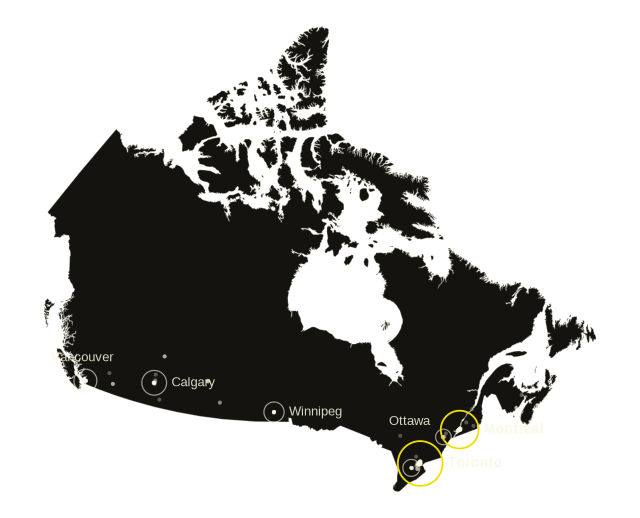
Map: Natural Earth
Cross Connects and Carrier Circuits
Cross Connect in Canada
A cross connect in Canada is ordered from the facility operator and the carriers present in the facility. Reboot Monkey places those orders for the customer, and its engineers install and patch the cabling in the customer's rack. Carrier circuits follow the same route, and prices are quoted on request.
15
of our services in Canada
Choose your city

Vancouver
- Cross Connects and Carrier Circuits
- Asset Audits and Inventory
- Data Center Decommissioning
- Data Center Migration
- Gpu Ai Cluster Deployment
- Ip Transit
- Rack and Network Design
- Rack and Stack
- Remote Hands
- Server Migration
- Smart Hands
- Structured Cabling
Services in Cross Connects and Carrier Circuits
In depth
Cross Connects and Carrier Circuits: 6 sections, open any to read more.
Cross Connect in Canada: How It Works
Reboot Monkey sells the network for the rack. For a customer in Canada, that starts with a cross connect or a carrier circuit. Both involve parties outside the customer's own equipment: the facility operator and the carriers present in the facility. The work is physical, it takes place inside a data center, and it is carried out to the customer's instruction.
In a cross connect order, Reboot Monkey is neither the carrier nor the facility operator. It is the party that orders the connection from them and that does the physical work in the customer's rack. For the buyer, the practical consequence is that the ordering and the cabling sit with Reboot Monkey, while the connection itself is supplied by the operator and the carriers. That division is the same for every cross connect and every carrier circuit, and it shapes each step of a request.
First comes the instruction, which sets the scope of the job. A request is easiest to place when it names the facility and the rack that will receive the cabling, and says which kind of connection is needed: a cross connect, a carrier circuit, or a longer link between data centres such as dark fibre or a wavelength. The instruction can also say whether the connection belongs to a new deployment or to equipment already in the rack. The facility name is the one fact an order cannot do without, because the operator and the carriers are those of that facility. A connection in a second facility is ordered from that facility's operator and carriers. Where the customer does not yet hold a rack, rack space is also something Reboot Monkey sells, and IPv4 leasing is offered alone or together with IP transit and rack space under one agreement.
Second comes the order. The carriers an order can name are the carriers present in the facility, so the choice of carrier is set by the building and not by Reboot Monkey. The facility operator is the other party to the order. Reboot Monkey places the requests with both and then carries out the installation in the rack.
Third comes the installation, the hands-on step. Reboot Monkey engineers are dispatched to the customer's facility to carry out this step, and they install and patch the cabling in the customer's rack. The facility operator owns and runs the building, including its power, cooling and access policy, and Reboot Monkey engineers work under the operator's site rules.
Fourth is cover for the customer site. A second, briefed Reboot Monkey engineer is named as backup for every customer site, so the backup applies to cross connect work in the same way as to any other job there.
Prices are quoted on request and depend on the customer and the size of the job. A request that states the facility, the rack and the connection required gives the quote the information it needs.
Datacenter Landscape in Canada
Data centres in Canada, ordered by the number of networks present:
- Telehouse Toronto (151 Front St West) (Telehouse - Global Data Centers), 151 Front Street West, Toronto M5J 2N1: 143 networks; carriers EBOX, Hive Data Center and i3D.net
- Equinix TR2 - Toronto (Equinix, Inc.), 45 Parliament St, Toronto M5A 0G7: 92 networks; carriers Arelion
- Cologix TOR1 (Cologix, Inc.), 151 Front St W., Toronto M5J2N1: 85 networks; carriers Arelion
- Cologix MTL3 (Cologix, Inc.), 1250 Rene Levesque West, Montreal H3B 4W8: 84 networks; carriers Arelion, EBOX, EXA Infrastructure and i3D.net
- Harbour Centre Vancouver (Polaris Realty), 555 West Hastings St., Vancouver V6B 4N6: 61 networks; carriers Arelion and Ziply Fiber
- Equinix TR1 - Toronto (Equinix, Inc.), 151 Front St, Toronto M5J 2N1: 46 networks; carriers i3D.net
- Cologix VAN2 (Cologix, Inc.), 1050 W Pender Street, Vancouver V6E 3S7: 39 networks; carriers Arelion and Ziply Fiber
- Coloware YTZ1, 151 Front St W, Toronto M5J: 35 networks; carriers Hive Data Center and SG.GS
- Arrow Calgary DC2 (Arrow Group Inc), 2712 - 37th Ave NE, Calgary T1Y5L3: 33 networks
- Cologix VAN3 (Cologix, Inc.), 2828 Natal Street, Vancouver V5M 2H1: 32 networks; carriers Ziply Fiber
Cross Connect in Canada: What We Deliver
A cross connect order usually sits inside a larger deployment, so the practical question for a buyer is what else the same orders and the same engineers can cover. Reboot Monkey delivers the connection itself and the work around it, and each related service keeps a single definition, so a request can name exactly the services it needs and leave out the rest.
Beyond the cross connect and the carrier circuit, the network side has two further items, and they are bought differently. Dark fibre between data centres and wavelength circuits are ordered from the carriers, and the quote is given on request. IP transit is offered as Economy, Premium and DDoS Premium plans, and each plan is quoted per data center for the capacity the customer needs. Dark fibre and wavelengths are the items that run between data centres, while IP transit is the item sized by capacity.
Where a connection belongs to a new or expanding deployment, rack and network design covers the rack layout and the network topology of that deployment, ending with documentation of the design and a controlled handover. Rack and stack covers installing, mounting and cabling new hardware in the rack. A GPU or AI cluster is handled through GPU and AI cluster deployment, which covers racking, cabling and node swaps, and the same three tasks make up the GPU and AI deployment package. The services cover different stages of a deployment: the design describes it, the hardware is installed in the rack, and the cluster tasks apply to GPU and AI equipment.
Cabling appears in two services that should not be confused. For a cross connect or a carrier circuit, the cabling work belongs to the connection order and is done in the customer's rack. Structured cabling is a separate service, and it covers installing, labelling and patching the cabling between the customer's racks and network equipment.
Hardware can be part of the same request. Hardware supply and spares covers data-centre hardware, servers, network equipment and spare parts, and spares are kept in the customer's rack on request. The supply covers equipment for a new deployment and replacement parts for an existing one, and equipment supplied this way is installed through rack and stack.
Once the connection and the equipment are in place, the support services apply. Remote hands covers physical tasks carried out on the customer's instruction, such as reboots, cable checks, component swaps and visual checks. Smart hands covers technical work that needs diagnostic judgement and configuration knowledge. That is the difference between the two: a task that needs only an instruction is remote hands, and a task that needs a decision about the configuration is smart hands. Both are delivered by Reboot Monkey engineers in the facility.
Hardware monitoring is the monitoring of the customer's servers and network equipment by the Reboot Monkey NOC. It is done from the NOC, while the cabling is done by engineers in the facility, so the two sit in different places of work.
Why Reboot Monkey for Cross Connect in Canada
Reboot Monkey sells rack space, IP transit, leased IP addresses, network, data-centre hardware and the services that deliver, install and support them. For a buyer who needs a connection in Canada, that means the connection, the rack space, the transit and the addresses can be bought from the same operator that orders and patches the cabling. Reboot Monkey is a third-party datacenter services operator, and it is not a hosting company.
A deployment that starts from nothing needs rack space, a connection, IP transit, leased addresses, hardware and cabling, and then support once the equipment is running. Each of those is a Reboot Monkey service, and the services are separate in scope, so a buyer can take the connection alone or together with any of the others.
For a customer that would rather not own the equipment, IT infrastructure turnkey and run is available. You or your investors fund the IT infrastructure. Reboot Monkey buys, installs, configures and then runs it for you, inside the data center you choose.
Recurring work can be arranged in advance. Remote hands retainers and hour blocks cover remote hands agreed as a retainer or as a block of hours for recurring work, with terms agreed per customer and quoted on request.
Equipment changes over time, and Reboot Monkey covers the physical side of those changes. Server migration covers moving equipment between racks, rooms or facilities. Datacenter exit and relocation covers the physical move of the customer's equipment to its new location together with the removal and disposal of the hardware that is retired. Asset inventory covers recording the customer's equipment in the data center by serial number, asset tag and rack position, against the customer's asset list.
When equipment is retired, data center decommissioning covers removing and disposing of the retired hardware. IT asset disposition (ITAD) covers data wiping, on-site shredding or degaussing, collection and transport, and resale or buyback quoted case by case, all processed by Reboot Monkey staff in a partner's processing facility or on the customer's site. ITAD with buyback adds the buyback of the retired hardware to that disposition.
As of 2026, Reboot Monkey's field engineers work in 190 countries and more than 400 locations. For a connection in Canada, Reboot Monkey engineers are dispatched to the facility where the customer's rack stands.
How Reboot Monkey Works
These terms apply in every facility in Canada where Reboot Monkey engineers work.
- Scope: Reboot Monkey orders cross connects and carrier circuits from the facility operator and the carriers present in the facility, and its engineers install and patch the cabling in the customer's rack.
- Response: 1-hour, around-the-clock incident response SLA, and a 15 minute premium response available where technicians are stationed on-site, as a paid add-on. The incident response SLA covers incidents and unplanned requests; on-site, dispatch and resolution times, priority tiers, and planned or scheduled work are agreed per site in the service agreement.
- Monitoring: 24/7 NOC monitoring across all facilities, covering IPMI, iDRAC, SNMP, temperature, power, network signals.
- Hardware: vendor-neutral technicians for Dell, HP, Cisco, Juniper and Arista equipment.
- Independence: independent from facility operators (not Equinix SmartHands, not NTT staff).
- One agreement: single provider across cities, so a customer in several cities needs only one agreement.
- Service levels and terms: https://www.rebootmonkey.com/en/solutions/sla
- Published case study: a major ICT provider engaged Reboot Monkey for three full infrastructure rollouts in Lahore, Karachi and Islamabad, with the hardware installed the same day at every site. Read the case study at https://www.rebootmonkey.com/en/resources/case-study/how-we-completed-3-full-deployments-across-pakistan
Cross Connects and Carrier Circuits
The data centres we work in hold their own certifications, such as ISO/IEC 27001 and ISO 9001. Ask us for the certificate of your site.
Frequently Asked Questions
What does cross-connects and carrier circuits cover in Canada?
In Canada, cross-connects and carrier circuits cover the ordering and the physical installation of connections. Reboot Monkey orders them from the facility operator and the carriers present in the facility, and its engineers install and patch the cabling in the customer's rack. Dark fibre and wavelength circuits are ordered from the carriers and quoted on request. Prices are quoted on request and depend on the customer and the size of the job.
Do you work in every datacenter in Canada?
Reboot Monkey engineers work in any facility in Canada where the customer has equipment and access, under the operator's own access and safety rules. The customer adds the engineers to the facility's access list before the first visit.
How fast can Reboot Monkey respond in Canada?
Incidents and unplanned requests are handled under a 1-hour, around-the-clock incident response SLA. There is also a 15 minute premium response available where technicians are stationed on-site, as a paid add-on. On-site, dispatch and resolution times, priority tiers, and planned or scheduled work are agreed per site in the service agreement.
How is Reboot Monkey different from the facility operator's own staff?
Facility operators' own technicians work for the building. Reboot Monkey engineers work for the customer: they are independent from facility operators (not Equinix SmartHands, not NTT staff), follow the customer's instructions, and the same team can cover several buildings in the country under one agreement.
How do I get started with cross-connects and carrier circuits in Canada?
Send the site, the equipment and the task through the contact form. Reboot Monkey replies with a quote and an engineer plan for that facility. Once agreed, the customer adds the engineers to the facility's access list and the cross-connects and carrier circuits work is scheduled under the operator's rules.
Cities we cover in Canada
Request a quote for a cross connect in Canada
Send the facility, the rack and the connection required, and Reboot Monkey will quote the job.