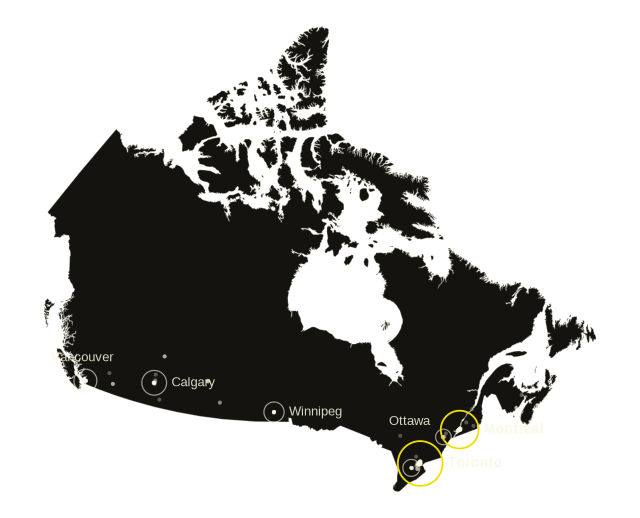
Map: Natural Earth
Ip Transit
Internet Transit in Canada
Internet transit in Canada connects a customer's network to the rest of the internet through an upstream provider. Reboot Monkey sells IP transit as Economy, Premium and DDoS Premium plans, quoted per data center for the capacity needed, and its engineers install and patch the cabling in the customer's rack.
15
of our services in Canada
Choose your city

Vancouver
- Ip Transit
- Asset Audits and Inventory
- Cross Connects and Carrier Circuits
- Data Center Decommissioning
- Data Center Migration
- Gpu Ai Cluster Deployment
- Rack and Network Design
- Rack and Stack
- Remote Hands
- Server Migration
- Smart Hands
- Structured Cabling
In depth
Ip Transit: 7 sections, open any to read more.
Internet Transit in Canada: How It Works
Internet transit is the service that connects a customer's network to the rest of the internet through an upstream provider. The provider accepts the customer's outbound traffic, carries it across its own network and hands it to other networks. It does the same in reverse for traffic addressed to the customer. The customer buys capacity into one provider instead of arranging a direct relationship with every network it needs to reach. In Canada, Reboot Monkey sells this service as a third-party datacenter services operator. The transit is delivered inside data centers that other companies own and run, and Reboot Monkey is neither a hosting company nor a datacenter owner.
A transit service has a logical side and a physical side, and both must be in place before traffic flows. The logical side is the capacity, the address space and the routing session between the customer's equipment and the provider. The physical side is the circuit that reaches the customer's rack and the cabling that terminates it. A buyer who treats only the logical side as the order usually finds the physical side is what delays the start of service, which is why Reboot Monkey handles both under the same request.
IP transit is offered as Economy, Premium and DDoS Premium plans, each quoted per data center for the capacity the customer needs. A request therefore starts with two decisions: the data center where the service is needed and the capacity required there. Prices are quoted on request and depend on the customer and the size of the job.
A network connected to one upstream provider is single-homed, and a network connected to more than one is multi-homed. Which arrangement fits depends on how much interruption the customer's service can absorb, and that decision stays with the customer's network team. Where the customer wants help turning the decision into a rack layout and a network topology, that work is available as a separate service.
Before asking for a quote, a buyer should have the following to hand: the data center, the capacity, and whether leased IP addresses and rack space are needed in the same agreement. With those three answers a quote can be prepared for that specific data center rather than for Canada in general.
Datacenter Landscape in Canada
Data centres in Canada, ordered by the number of networks present:
- Telehouse Toronto (151 Front St West) (Telehouse - Global Data Centers), 151 Front Street West, Toronto M5J 2N1: 143 networks; carriers EBOX, Hive Data Center and i3D.net
- Equinix TR2 - Toronto (Equinix, Inc.), 45 Parliament St, Toronto M5A 0G7: 92 networks; carriers Arelion
- Cologix TOR1 (Cologix, Inc.), 151 Front St W., Toronto M5J2N1: 85 networks; carriers Arelion
- Cologix MTL3 (Cologix, Inc.), 1250 Rene Levesque West, Montreal H3B 4W8: 84 networks; carriers Arelion, EBOX, EXA Infrastructure and i3D.net
- Harbour Centre Vancouver (Polaris Realty), 555 West Hastings St., Vancouver V6B 4N6: 61 networks; carriers Arelion and Ziply Fiber
- Equinix TR1 - Toronto (Equinix, Inc.), 151 Front St, Toronto M5J 2N1: 46 networks; carriers i3D.net
- Cologix VAN2 (Cologix, Inc.), 1050 W Pender Street, Vancouver V6E 3S7: 39 networks; carriers Arelion and Ziply Fiber
- Coloware YTZ1, 151 Front St W, Toronto M5J: 35 networks; carriers Hive Data Center and SG.GS
- Arrow Calgary DC2 (Arrow Group Inc), 2712 - 37th Ave NE, Calgary T1Y5L3: 33 networks
- Cologix VAN3 (Cologix, Inc.), 2828 Natal Street, Vancouver V5M 2H1: 32 networks; carriers Ziply Fiber
Internet Transit in Canada: What We Deliver
Transit is rarely ordered alone. It arrives together with address space, rack space, cabling and the hands that connect them. Each service below is delivered by Reboot Monkey as defined here.
- IPv4 leasing: leasing IPv4 addresses, alone or together with IP transit and rack space under one agreement.
- Cross-connects and carrier circuits: ordered from the facility operator and the carriers present in the facility, with Reboot Monkey engineers installing and patching the cabling in the customer's rack.
- Rack and stack: installing, mounting and cabling new hardware.
- Structured cabling: installing, labelling and patching the cabling between the customer's racks and network equipment.
- Rack and network design: the rack layout and the network topology of a new or expanding deployment, ending with documentation of the design and a controlled handover.
- Hardware supply and spares: supply of data-centre hardware, servers, network equipment and spare parts, with spares kept in the customer's rack on request.
- Remote hands: physical tasks carried out on the customer's instruction, such as reboots, cable checks, component swaps and visual checks.
- Smart hands: technical work that needs diagnostic judgement and configuration knowledge.
IP Transit vs Peering in Canada
IP transit and peering both move traffic between networks, but they differ in who is reached and under what arrangement. With transit, a provider is paid to carry the customer's traffic to and from the whole internet. With peering, two networks connect directly and exchange traffic only for the destinations each one announces to the other: its own addresses and those of its own customers.
That difference shapes how each is used. Transit gives a network full reach through a single commercial relationship, with the provider responsible for onward delivery. Peering reaches only the peer's destinations, so a network that relies on it still needs a route to everything else, and that route is normally transit. For this reason the two are usually combined rather than chosen against each other, and a network that peers still keeps a transit service as its route to the rest of the internet.
Reboot Monkey's role sits on the transit side and on the physical side of both. It sells IP transit as a service delivered into the customer's rack in the data center. A direct connection to another network in the same building is a cross connect. Reboot Monkey orders cross connects from the facility operator and the carriers present in the facility, and its engineers install and patch the cabling in the customer's rack, in the same way as for a transit circuit.
For a buyer weighing the two, the practical questions are operational. How much capacity is needed in the data center, what the routing policy of the customer's network requires, and who will handle the cabling when circuits change. The routing policy and the choice of networks to peer with remain the customer's decisions. The plan, the capacity and the physical work are what Reboot Monkey takes on.
Why Reboot Monkey for Internet Transit in Canada
IP transit, rack space, leased IP addresses and on-site engineers come from one provider, under one agreement. For a procurement manager this means a single counterparty for the connection and for the physical work around it. For an IT director it means that the person who patches the cable in the rack works for the same company that sold the circuit.
The facility operator owns and runs the building, including its power, cooling and access policy, and Reboot Monkey engineers work under the operator's site rules. Reboot Monkey engineers are dispatched to the customer's facility, and a second, briefed Reboot Monkey engineer is named as backup for every customer site. A named backup matters on a transit connection because a circuit fault does not wait for a particular engineer to be available.
As of 2026, Reboot Monkey's field engineers work in 190 countries and more than 400 locations. For a customer with equipment in Canada and elsewhere, multi-site rollouts are one installation programme carried out at several of the customer's sites by Reboot Monkey engineers, under one agreement.
Work that continues after the transit is live can sit with the same provider. Remote hands can be agreed as a retainer or as a block of hours for recurring work, with terms agreed per customer and quoted on request. Hardware monitoring is carried out by the Reboot Monkey NOC on the customer's servers and network equipment. For customers who want the whole stack handled, IT infrastructure turnkey and run means that the customer or its investors fund the IT infrastructure, and Reboot Monkey buys, installs, configures and then runs it inside the data center the customer chooses. The data center itself stays with its operator.
When a deployment ends, datacenter exit and relocation covers the physical move of the customer's equipment to its new location, together with the removal and disposal of the hardware that is retired.
How Reboot Monkey Works
These terms apply in every facility in Canada where Reboot Monkey engineers work.
- Scope: IP transit is offered as Economy, Premium and DDoS Premium plans, each quoted per data center for the capacity the customer needs.
- Scope: IP transit, rack space, leased IP addresses and on-site engineers come from one provider, under one agreement.
- Response: 1-hour, around-the-clock incident response SLA, and a 15 minute premium response available where technicians are stationed on-site, as a paid add-on. The incident response SLA covers incidents and unplanned requests; on-site, dispatch and resolution times, priority tiers, and planned or scheduled work are agreed per site in the service agreement.
- Monitoring: 24/7 NOC monitoring across all facilities, covering IPMI, iDRAC, SNMP, temperature, power, network signals.
- Hardware: vendor-neutral technicians for Dell, HP, Cisco, Juniper and Arista equipment.
- Independence: independent from facility operators (not Equinix SmartHands, not NTT staff).
- One agreement: single provider across cities, so a customer in several cities needs only one agreement.
- Service levels and terms: https://www.rebootmonkey.com/en/solutions/sla
- Published case study: a major ICT provider engaged Reboot Monkey for three full infrastructure rollouts in Lahore, Karachi and Islamabad, with the hardware installed the same day at every site. Read the case study at https://www.rebootmonkey.com/en/resources/case-study/how-we-completed-3-full-deployments-across-pakistan
Ip Transit
The data centres we work in hold their own certifications, such as ISO/IEC 27001 and ISO 9001. Ask us for the certificate of your site.
Frequently Asked Questions
What is the difference between IP transit and IP peering?
IP transit is a service in which an upstream provider carries a customer's traffic to and from the whole internet for a quoted capacity. IP peering is a direct exchange of traffic between two networks, limited to the destinations those networks announce to each other. Reboot Monkey sells IP transit as Economy, Premium and DDoS Premium plans, and its engineers install the cabling for cross connects.
What does IP transit cover in Canada?
IP transit in Canada is offered as Economy, Premium and DDoS Premium plans, each quoted per data center for the capacity the customer needs. It can be combined with leased IP addresses, rack space and on-site engineers under one agreement. Cross connects and carrier circuits are ordered from the facility operator and the carriers present, and Reboot Monkey engineers install and patch the cabling in the customer's rack.
Do you work in every datacenter in Canada?
Reboot Monkey engineers work in any facility in Canada where the customer has equipment and access, under the operator's own access and safety rules. The customer adds the engineers to the facility's access list before the first visit.
How fast can Reboot Monkey respond in Canada?
Incidents and unplanned requests are handled under a 1-hour, around-the-clock incident response SLA. There is also a 15 minute premium response available where technicians are stationed on-site, as a paid add-on. On-site, dispatch and resolution times, priority tiers, and planned or scheduled work are agreed per site in the service agreement.
How is Reboot Monkey different from the facility operator's own staff?
Facility operators' own technicians work for the building. Reboot Monkey engineers work for the customer: they are independent from facility operators (not Equinix SmartHands, not NTT staff), follow the customer's instructions, and the same team can cover several buildings in the country under one agreement.
How do I get started with ip transit in Canada?
Send the site, the equipment and the task through the contact form. Reboot Monkey replies with a quote and an engineer plan for that facility. Once agreed, the customer adds the engineers to the facility's access list and the ip transit work is scheduled under the operator's rules.
Cities we cover in Canada
Request a quote for IP transit
Tell Reboot Monkey the data center and the capacity you need, and the Economy, Premium or DDoS Premium plan will be quoted for that data center.