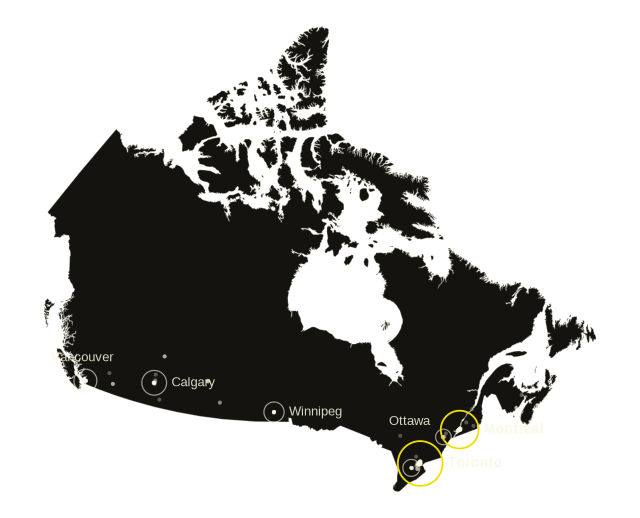
Map: Natural Earth
Gpu Ai Cluster Deployment
GPU AI Cluster Deployment in Canada
GPU AI cluster deployment in Canada covers racking, cabling and node swaps. Reboot Monkey engineers carry out the physical work on your GPU or AI cluster inside the customer's data center, as a third-party datacenter services operator that neither hosts clusters nor owns the facility.
15
of our services in Canada
Choose your city

Vancouver
- Gpu Ai Cluster Deployment
- Asset Audits and Inventory
- Cross Connects and Carrier Circuits
- Data Center Decommissioning
- Data Center Migration
- Ip Transit
- Rack and Network Design
- Rack and Stack
- Remote Hands
- Server Migration
- Smart Hands
- Structured Cabling
Services in Gpu Ai Cluster Deployment
In depth
Gpu Ai Cluster Deployment: 6 sections, open any to read more.
GPU and AI Cluster Deployment in Canada
GPU and AI cluster deployment in Canada covers racking, cabling and node swaps. Reboot Monkey engineers carry out this work in the customer's data center on the customer's instruction, so that the hardware of a GPU or AI cluster is mounted and cabled in the positions the deployment calls for.
Reboot Monkey is a third-party datacenter services operator. It sells rack space, IP transit, leased IP addresses, network, data-centre hardware and the services that deliver, install and support them, inside data centres that other companies own and run. It is not a hosting company and it does not own datacenters, so a cluster deployment in Canada is always work inside a building run by someone else. The facility operator owns and runs the building, including its power, cooling and access policy, and Reboot Monkey engineers work under the operator's site rules.
The scope has three parts, and each is a defined physical task. Racking is installing and mounting hardware in the customer's racks. Cabling is installing, labelling and patching the cabling between the customer's racks and network equipment. A node swap is the physical exchange of a node in a cluster that is already installed. Together they cover the part of a cluster project that takes place in the data center. Racking and cabling are carried out against the layout the customer holds or has designed.
The scope named for this service is racking, cabling and node swaps. Work that goes further, such as technical tasks that need diagnostic judgement and configuration knowledge, belongs to smart hands, a separate service that can be requested alongside the deployment.
Hardware for the cluster can come from the customer or be supplied by Reboot Monkey. Either way, the racking, cabling and node swaps are carried out by Reboot Monkey engineers, and the three tasks stay the same whichever source is used.
A request starts with a description of the cluster and the data center it is going into. Reboot Monkey scopes the work against the three tasks above and quotes it.
Useful inputs for scoping are the data center the cluster is going into, the list of hardware, and the intended rack layout. Where no layout exists, rack and network design produces one: the rack layout and the network topology of a new or expanding deployment.
Reboot Monkey engineers are dispatched to the customer's data center for each of these tasks. The customer decides which data center the cluster goes into. A cluster project can be a first installation, an expansion of a cluster already running, or recurring node swaps. Each of these cases uses the same three tasks.
The GPU and AI deployment package is the same scope under another name: racking, cabling and node swaps for a GPU or AI cluster. Teams that refer to the offer by either name receive the same scope.
Datacenter Landscape in Canada
Data centres in Canada, ordered by the number of networks present:
- Telehouse Toronto (151 Front St West) (Telehouse - Global Data Centers), 151 Front Street West, Toronto M5J 2N1: 143 networks; carriers EBOX, Hive Data Center and i3D.net
- Equinix TR2 - Toronto (Equinix, Inc.), 45 Parliament St, Toronto M5A 0G7: 92 networks; carriers Arelion
- Cologix TOR1 (Cologix, Inc.), 151 Front St W., Toronto M5J2N1: 85 networks; carriers Arelion
- Cologix MTL3 (Cologix, Inc.), 1250 Rene Levesque West, Montreal H3B 4W8: 84 networks; carriers Arelion, EBOX, EXA Infrastructure and i3D.net
- Harbour Centre Vancouver (Polaris Realty), 555 West Hastings St., Vancouver V6B 4N6: 61 networks; carriers Arelion and Ziply Fiber
- Equinix TR1 - Toronto (Equinix, Inc.), 151 Front St, Toronto M5J 2N1: 46 networks; carriers i3D.net
- Cologix VAN2 (Cologix, Inc.), 1050 W Pender Street, Vancouver V6E 3S7: 39 networks; carriers Arelion and Ziply Fiber
- Coloware YTZ1, 151 Front St W, Toronto M5J: 35 networks; carriers Hive Data Center and SG.GS
- Arrow Calgary DC2 (Arrow Group Inc), 2712 - 37th Ave NE, Calgary T1Y5L3: 33 networks
- Cologix VAN3 (Cologix, Inc.), 2828 Natal Street, Vancouver V5M 2H1: 32 networks; carriers Ziply Fiber
Our GPU and AI Cluster Deployment Services in Canada
Racking comes first, because cabling is installed and patched between the customer's racks and network equipment that are already in place. Node swaps follow once the cluster is in service.
A new cluster starts with the layout. Rack and network design supplies the layout where the customer has none. Racking and cabling then follow that layout, cross-connects and carrier circuits are ordered for the connectivity the cluster needs, and an inventory taken after the work records what stands in each rack.
An expansion adds nodes to a cluster that is already running. The work is racking and cabling for the new nodes, followed by an inventory so that the asset list matches the rack.
A node swap changes one position in the rack and leaves the rest of the cluster in place. The node that is replaced is removed, and the new node is installed and cabled in its position.
Maintenance centres on node swaps. When swaps recur, they can be placed under a remote hands retainer, with terms agreed per customer and quoted on request.
Clusters are also moved and retired. Server migration moves equipment between racks, rooms or facilities. Data center decommissioning removes and disposes of retired hardware. Datacenter exit and relocation combines the physical move of the customer's equipment to its new location with the removal and disposal of the hardware that is retired.
A cluster also needs network at the rack. Reboot Monkey sells IP transit as Economy, Premium and DDoS Premium plans, each quoted per data center for the capacity the customer needs, and leases IPv4 addresses alone or together with IP transit and rack space under one agreement.
At the end of a task the customer receives the result in the form the task defines: a mounted and cabled cluster for racking and cabling, a documented design and a controlled handover for rack and network design, and an inventory by serial number, asset tag and rack position for asset records.
The services that can accompany a cluster project are defined by what Reboot Monkey engineers or staff do:
- Cross-connects and carrier circuits: ordered from the facility operator and the carriers present in the facility, with Reboot Monkey engineers installing and patching the cabling in the customer's rack.
- Asset inventory: recording the customer's equipment in the data center by serial number, asset tag and rack position, against the customer's asset list.
- Hardware supply and spares: supply of data-centre hardware, servers, network equipment and spare parts, with spares kept in the customer's rack on request.
- Remote hands and retainers: physical tasks carried out on the customer's instruction (reboots, cable checks, component swaps, visual checks), agreed as a retainer or as a block of hours for recurring work.
- Hardware monitoring: monitoring of the customer's servers and network equipment by the Reboot Monkey NOC.
Why Reboot Monkey in Canada
Reboot Monkey carries out the physical work on a cluster inside the data center the customer chooses. As of 2026, Reboot Monkey's field engineers work in 190 countries and more than 400 locations.
A second, briefed Reboot Monkey engineer is named as backup for every customer site. The backup applies to the site where the cluster stands, whether the work is a first installation or a later node swap.
A cluster project can also be set up as IT infrastructure turnkey and run. You or your investors fund the IT infrastructure. Reboot Monkey buys, installs, configures and then runs it for you, inside the data center you choose.
Customers with clusters at several sites can run the work as a multi-site rollout: one installation programme carried out at several of the customer's sites by Reboot Monkey engineers, under one agreement.
For a procurement manager, the useful property of this service is that its edges are defined. The scope is racking, cabling and node swaps. Related services are named separately, each with its own definition, and a quote is tied to the customer and the size of the job. A request can therefore be compared against the scope line by line.
For a CTO or IT Director, the decision comes down to where responsibility changes hands. Inside the customer's rack, Reboot Monkey engineers install and patch cabling and carry out node swaps. At the edge of the network, Reboot Monkey orders the circuits from the carriers present in the facility. The customer's own teams remain responsible for what runs on the cluster.
Clusters that span buildings need links between them. Dark fibre between data centres and wavelength circuits are ordered from the carriers and quoted on request.
After the deployment, the day-to-day physical tasks come from the same company: remote hands for reboots, cable checks, component swaps and visual checks, and the Reboot Monkey NOC for monitoring the customer's servers and network equipment. The customer deals with one provider for the installation and the tasks around it.
A quote is provided on request. It depends on the customer and the size of the job, so the same service can be quoted differently for a single rack and for a programme across several sites.
Five points are worth settling before a quote is requested:
- The data center the cluster goes into, which the customer chooses.
- The tasks included: racking, cabling and node swaps, with any related service named separately.
- Who supplies the hardware: the customer, or Reboot Monkey through hardware supply.
- Whether the work covers one site or several, and whether it sits under one agreement.
- Whether node swaps are one-off requests or recurring work placed under a retainer or a block of hours.
How Reboot Monkey Works
These terms apply in every facility in Canada where Reboot Monkey engineers work.
- Scope: GPU and AI cluster deployment covers racking, cabling and node swaps.
- Response: 1-hour, around-the-clock incident response SLA, and a 15 minute premium response available where technicians are stationed on-site, as a paid add-on. The incident response SLA covers incidents and unplanned requests; on-site, dispatch and resolution times, priority tiers, and planned or scheduled work are agreed per site in the service agreement.
- Monitoring: 24/7 NOC monitoring across all facilities, covering IPMI, iDRAC, SNMP, temperature, power, network signals.
- Hardware: vendor-neutral technicians for Dell, HP, Cisco, Juniper and Arista equipment.
- Independence: independent from facility operators (not Equinix SmartHands, not NTT staff).
- One agreement: single provider across cities, so a customer in several cities needs only one agreement.
- Service levels and terms: https://www.rebootmonkey.com/en/solutions/sla
- Published case study: a major ICT provider engaged Reboot Monkey for three full infrastructure rollouts in Lahore, Karachi and Islamabad, with the hardware installed the same day at every site. Read the case study at https://www.rebootmonkey.com/en/resources/case-study/how-we-completed-3-full-deployments-across-pakistan
Gpu Ai Cluster Deployment
The data centres we work in hold their own certifications, such as ISO/IEC 27001 and ISO 9001. Ask us for the certificate of your site.
Frequently Asked Questions
What does GPU and AI cluster deployment cover in Canada?
In Canada, GPU and AI cluster deployment covers racking, cabling and node swaps, carried out by Reboot Monkey engineers in the customer's data center. Rack and network design, cross-connects, asset inventory, hardware supply and remote hands retainers are separate services that can be requested alongside it. Quotes are provided on request and depend on the customer and the size of the job.
Do you work in every datacenter in Canada?
Reboot Monkey engineers work in any facility in Canada where the customer has equipment and access, under the operator's own access and safety rules. The customer adds the engineers to the facility's access list before the first visit.
How fast can Reboot Monkey respond in Canada?
Incidents and unplanned requests are handled under a 1-hour, around-the-clock incident response SLA. There is also a 15 minute premium response available where technicians are stationed on-site, as a paid add-on. On-site, dispatch and resolution times, priority tiers, and planned or scheduled work are agreed per site in the service agreement.
How is Reboot Monkey different from the facility operator's own staff?
Facility operators' own technicians work for the building. Reboot Monkey engineers work for the customer: they are independent from facility operators (not Equinix SmartHands, not NTT staff), follow the customer's instructions, and the same team can cover several buildings in the country under one agreement.
How do I get started with gpu and ai cluster deployment in Canada?
Send the site, the equipment and the task through the contact form. Reboot Monkey replies with a quote and an engineer plan for that facility. Once agreed, the customer adds the engineers to the facility's access list and the gpu and ai cluster deployment work is scheduled under the operator's rules.
Cities we cover in Canada
Plan your GPU or AI cluster deployment in Canada
Send the data center, the hardware list and the type of work, and Reboot Monkey will scope and quote the racking, cabling and node swaps.