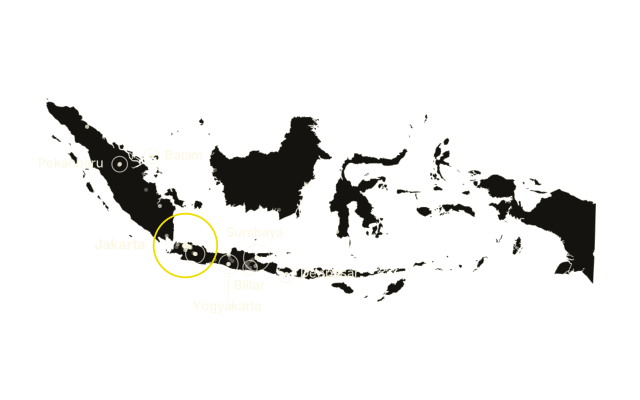
Map: Natural Earth
ITAD
ITAD in Indonesia: IT Asset Disposition
ITAD in Indonesia means Reboot Monkey collects retired IT hardware at the customer's site or data centre, transports it for processing, and handles the storage media by data wiping or physical destruction. Equipment that can be used again goes to resale or buyback, quoted case by case.
8
of our services in Indonesia
Services in ITAD
- ITAD
- Colocation
- Data Center Decommissioning
- Data Center Migration
- Rack and Stack
- Server Migration
- Smart Hands
- Remote Handson request
In depth
ITAD: 6 sections, open any to read more.
ITAD in Indonesia: How It Works
An ITAD request in Indonesia is handled as one piece of work, from the first message to the moment the last item leaves the site. The customer does not book transport with one party, data destruction with a second and resale with a third. The request names the hardware that is being retired, the place where it stands and what has to happen to the data on it, and Reboot Monkey organises the work around those inputs.
The first decision is scope. A retired estate is rarely uniform. Some machines hold storage media that are to be destroyed, some hold media that can be wiped, and some are complete systems that may still be worth reselling. Separating these groups at the start of the request matters because each group follows a different route after collection. A customer who supplies a list of the equipment, the location of each item and the intended treatment of its drives gives the engineers what they need to plan the visit.
Processing takes place in either of these settings, and the choice is the customer's. Work on the customer's site suits media that the customer wants destroyed before they leave the premises, because storage media can be destroyed physically on the customer's site by shredding or degaussing. Work in a partner's processing facility suits hardware that is collected and moved first, with the data wiping and the resale or buyback question handled after transport. In both settings the people doing the work are Reboot Monkey staff.
Resale and buyback are a separate commercial question from destruction. Whether a set of equipment can be used again, and what it is worth, is quoted case by case. The customer should decide early which machines are candidates for reuse, since that decision sits alongside the choice between wiping and physical destruction of the storage media.
The IT director who owns the hardware, the procurement manager who asks for the quote and whoever is responsible for personal data in the organisation each have a stake in the request. Bringing all of them into the first message means the scope is settled once, before any engineer is dispatched to the site.
A request for a single rack and a request for a full room follow the same stages. What changes is the length of the scope list.
In order, a request moves through these stages:
- Scope: the customer states which hardware is retired, where it stands, and whether its storage media is to be wiped or destroyed physically.
- Collection: Reboot Monkey collects the retired hardware at the customer's site or data centre.
- Transport: the collected hardware is transported for processing.
- Processing: Reboot Monkey staff carry out the work in a partner's processing facility or on the customer's site.
- Resale or buyback: equipment that can be used again is quoted case by case.
Personal Data on Retired Drives in Indonesia
In Indonesia, personal data on retired drives falls under the Law No. 27 of 2022 concerning Personal Data Protection.
For an ITAD request, that fact shapes the first question about any item of hardware: does it contain a drive, and what is on that drive? Servers, storage systems and network devices can all hold storage media, and a drive that has been taken out of service still holds whatever was written to it. Retiring a machine does not remove the data. A deliberate treatment step does, and that step is part of every ITAD request: the customer chooses between data wiping and physical destruction of the storage media.
Location in the process does not change what a drive contains. A drive in a rack, in transit or waiting for processing is the same drive with the same contents. For that reason the movement of retired hardware belongs to the data protection question as much as the destruction step does. Reboot Monkey collects the retired hardware at the customer's site or data centre and transports it for processing, so the customer deals with one party for the movement of drives from the rack to the point of treatment.
A request can treat drives differently from one another. Drives from one system may be destroyed on the site while drives from another travel to the partner's processing facility to be wiped. Drives that are no longer in any machine, for example spares from a storeroom, are part of the same request when the customer lists them. The point is that every drive in scope is assigned a route when the request is made, not after the hardware has left the building.
The customer's data protection owner should be named in the request, because the choice of route for each drive is set at that point. Reboot Monkey carries out the physical handling the customer has chosen: collection, transport, wiping or destruction, and processing by its own staff.
Where drives hold data of different sensitivity, the customer can ask for the stricter route for all of them. Choosing physical destruction for a whole group of drives is a decision about scope, and it is made in the same message as the equipment list.
A scope list is most useful when it records, for each machine, where it stands, how many drives it contains and which route those drives follow. That level of detail lets the customer's own data protection owner read the list and see the intended treatment of every drive before any work starts.
The routes differ in where they happen and in what remains afterwards:
- Data wiping is carried out by Reboot Monkey staff in a partner's processing facility or on the customer's site, and it leaves the equipment available for resale or buyback where it can be used again.
- Physical destruction on the customer's site is done by shredding or degaussing, so the storage media are destroyed on the premises where they were in service.
How Collection and Destruction Work
Collection starts at the place where the hardware stands. That may be the customer's own site or a data centre where the customer rents space. In either case Reboot Monkey collects the retired hardware there and transports it for processing.
Where the hardware stands in a data centre, the facility operator owns and runs the building, including its power, cooling and access policy, and Reboot Monkey engineers work under the operator's site rules.
Destruction on the customer's site means that storage media can be destroyed physically by shredding or degaussing at the customer's premises. Reboot Monkey staff carry out this work on the site, and the customer states in the request which media are handled this way and by which of these methods. Media that are not destroyed on the site go with the rest of the hardware when it is transported for processing.
Hardware that travels is processed in a partner's processing facility, again by Reboot Monkey staff. The work there is the data wiping of storage media and, for equipment that can be used again, resale or buyback, which is quoted case by case. A customer that wants every storage medium destroyed before the hardware leaves the premises can choose on-site destruction for all of it.
The choice between the settings is also a choice about where the data-bearing hardware is while the work is done: on the customer's premises, or at the partner's processing facility after transport.
Items that are not storage media, such as chassis and network equipment, travel with the collected hardware. Whether they can be used again determines whether they belong in a resale or buyback quote.
ITAD is one of several services for hardware at different points of its life, and the boundaries matter when a request is written. Removing and disposing of retired hardware from an installation is data center decommissioning. Moving equipment between racks, rooms or facilities without retiring it is server migration. Installing, mounting and cabling new hardware is rack and stack. A customer that retires an installation and replaces it can therefore describe the project in parts, with the retired hardware handled as ITAD and the replacement hardware handled as rack and stack.
From the customer's side the sequence is short: send the request, settle the route for each group of drives, take the quote where resale or buyback applies, and arrange the collection.
A request is ready for planning when it contains:
- the name of the data centre where the hardware stands, or the address of the customer's own site;
- the list of equipment, with the location of each item;
- the route chosen for the storage media in each group: wiping, or destruction by shredding or degaussing on the customer's site;
- the items that are candidates for resale or buyback.
Why Reboot Monkey for ITAD in Indonesia
Reboot Monkey is a third-party datacenter services operator. It sells rack space, IP transit, leased IP addresses, network, data-centre hardware and the services that deliver, install and support them, inside data centres that other companies own and run. It is not a hosting company and it does not own datacenters. ITAD sits at the end of the same hardware life cycle that Reboot Monkey's other services cover, from installation to support.
Reboot Monkey does not host the customer's workloads and does not run the data centre where the hardware stands. Its role in ITAD is the physical end-of-life handling of the hardware: collection, transport, processing and the destruction or wiping of storage media.
The partner provides the processing facility. The work inside it is carried out by Reboot Monkey staff, and the same applies when the work is done on the customer's site. For a CTO weighing who touches data-bearing hardware, that is the relevant fact about the structure of the service.
As of 2026, Reboot Monkey's field engineers work in 190 countries and more than 400 locations.
A second, briefed Reboot Monkey engineer is named as backup for every customer site, and that applies to a site where retired hardware is collected as it does to any other.
Prices are quoted on request and depend on the customer and the size of the job. Procurement managers should send the equipment list with the quote request, because both the size of the job and the case-by-case resale or buyback question depend on it.
Customers who retire hardware usually keep other equipment in service. Besides ITAD, Reboot Monkey provides remote hands, smart hands and hardware monitoring, so the same supplier can handle the equipment that remains as well as the equipment that is leaving. Hardware monitoring is done by the Reboot Monkey NOC for the customer's servers and network equipment.
Where retired hardware is replaced, the replacement also needs rack space, IP transit and leased IP addresses, and Reboot Monkey sells these as well. It also sells the network for the rack: it orders the cross connects and carrier circuits from the facility operator and the carriers present in the facility, and Reboot Monkey engineers install and patch the cabling in the customer's rack. A customer can therefore plan the retirement of old hardware and the arrival of its replacement as one engagement with one supplier.
How Reboot Monkey Handles IT Asset Disposition
These terms apply to IT asset disposition in Indonesia.
- Where the work is done: the processing is done by Reboot Monkey's own staff, in a partner's processing facility or on the customer's site, agreed case by case.
- Resale and buyback: reusable hardware can be resold through Reboot Monkey's procurement desk or bought back, quoted case by case.
Data sanitization and certificates
The data centres we work in hold their own certifications, such as ISO/IEC 27001 and ISO 9001. Ask us for the certificate of your site. Our ITAD partner's sites include facilities certified to ISO 9001, ISO 14001, ISO/IEC 27001 and ISO 45001. Ask us for the certificate of the site that handles your job.
- NIST SP 800-88 data sanitization
- Certificate of Destruction issued per storage device processed
Frequently Asked Questions
What does IT asset disposition cover in Indonesia?
IT asset disposition covers the end-of-life handling of a customer's IT hardware: collection and transport, data wiping or physical destruction of the storage media, and resale or buyback of the equipment that can be used again. Reboot Monkey staff carry out the processing, in a partner's processing facility or on the customer's site, where storage media can be shredded or degaussed.
Where does Reboot Monkey process retired hardware in Indonesia?
The processing is done by Reboot Monkey's own staff, in a partner's processing facility or on the customer's site, agreed case by case. The customer and Reboot Monkey settle which of the two applies before the job is scheduled, and the collection and transport of the hardware are arranged with the customer.
Can retired hardware be resold or bought back in Indonesia?
Yes. Reusable hardware can be resold through Reboot Monkey's procurement desk or bought back, quoted case by case. Send the list of the hardware, with models and quantities, through the contact form, and Reboot Monkey replies with what can be resold or bought back.
How do I get a quote for IT asset disposition in Indonesia?
Prices are quoted on request and depend on the customer and the size of the job. Send the site, the list of the hardware and whether storage media must be destroyed on site through the contact form, and Reboot Monkey replies with a quote for the job.
Request ITAD in Indonesia
Send Reboot Monkey the equipment list, the place where the hardware stands and the intended treatment of the storage media.