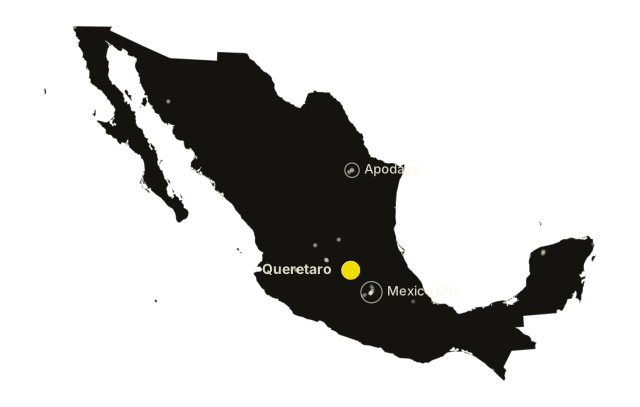
Map: Natural Earth
Rack and Stack
Server Racking in Mexico
Server racking in Mexico is the installing, mounting and cabling of new hardware in a data centre rack. Reboot Monkey engineers are dispatched to the customer's facility to carry out the cabling, labelling and power-on checks, and quotes are on request.
9
of our services in Mexico
Choose your city

Photo: Carlos Valenzuela · CC BY-SA 4.0 · source
Queretaro
- Rack and Stack
- Colocation
- Data Center Decommissioning
- Data Center Migration
- Remote Hands
- Server Migration
- Smart Hands
Services in Rack and Stack
In depth
Rack and Stack: 7 sections, open any to read more.
Server Racking in Mexico: How It Works
Rack and stack is the work of installing, mounting and cabling new hardware. For a company placing servers, switches or storage in a data centre in Mexico, it is the physical stage that turns delivered equipment into equipment that sits in a rack, is cabled and has been powered on, ready for the customer's own configuration. Reboot Monkey carries out this work inside data centres that other companies own and run.
The building belongs to someone else, and that shapes every job. The facility operator owns and runs the building, including its power, cooling and access policy, and Reboot Monkey engineers work under the operator's site rules. A rack and stack request in Mexico is handled within those rules from first contact to finished work.
Rack and stack applies to new hardware only. Equipment that is being moved or retired is a different job and is requested as a different service, so a buyer who installs new equipment and also retires older equipment sends two requests.
A request moves through these stages. The first is the request itself. The customer contacts Reboot Monkey and states which hardware is to be installed, which racks it goes into, what cabling the installation needs and where the site is. A request that names the devices, the target racks and the cabling lets the quote be tied to the size of the job.
The second stage is dispatch. Reboot Monkey engineers are dispatched to the customer's facility in Mexico to carry out the installation on the customer's request. The job is carried out against the details the customer supplied in the request.
The third stage is physical installation. Engineers mount each device in the customer's rack and cable it. Mounting fixes the device in its position in the rack, and cabling connects it to the rest of the installation, whether that is another device in the rack or a network connection that has been ordered for the rack.
The last stage is labelling and power-on checks, which close the job. Labelling identifies the cabling and the equipment that has been installed, and the power-on checks show that the newly installed hardware starts up. Once these are complete the hardware is in place and the customer continues with its own configuration.
For an IT Director or CTO, the decision points in a rack and stack request are concrete: the hardware to be installed, the racks it goes into, the cabling it needs and the site where the work happens. For a procurement manager, the same items define the job that is quoted. Each item can be written down before an engineer is dispatched, and the engineer works from that description. Changes to the request, such as additional devices or extra cabling, change the size of the job and therefore the quote.
Datacenter Landscape in Mexico
Data centres in Mexico, ordered by the number of networks present:
- KIO Querétaro 1 (QRO1), Privada de la Princesa 4, Parque Industrial el Marques, 76246: 69 networks; carriers Arelion, Cirion and EdgeUno
- Equinix MX1/MX2 - Mexico City (Equinix, Inc.), Carretera Estatal 431 Kilómetro 2+200, #79, Parque Tecnológico Innovación Querétaro, 76246 El Marques: 34 networks; carriers Arelion
- KIO México 5 (MEX5), Calle Benito Juárez 20 San Mateo Cuautepec, Fuentes del Valle, 54948 Tultitlan: 30 networks; carriers Arelion, Cirion and EdgeUno
- KIO México 2 (MEX2), Prolongacion Paseo de la Reforma 5396, La Rosita, El Yaqui, 05000 Cuajimalpa de Morelos: 25 networks; carriers Arelion and Cirion
- HostDime GDL Mexico Data Center, Avenida López Mateos Sur 2077, Col, Jardines Plaza del Sol, 44510 Guadalajara: 14 networks; carriers Arelion
- Ascenty QRO01 - Querétaro (Ascenty DataCenters e Telecom), Camino a Nativitas 800, 76295 Colón, Vesta Park Querétaro I, Queretaro: 13 networks; carriers Cirion and EdgeUno
- KIO México 1 (MEX1), Prolongacion Paseo de la Reforma 5287, La Rosita Lomas de Vista Hermosa, 05100 Cuajimalpa de Morelos: 12 networks; carriers EdgeUno
- KIO México 4 (MEX4), Blvd Magnocentro 6, Centro Urbano Interlomas, Interlomas, Villa de las Palmas, 52760 Huixquilucan: 12 networks
- Equinix MO1 - Monterrey (Equinix, Inc.), Parque Industrial Kalos de Alta Tecnología, Carretera Miguel Alemán Km 17, Street: 112 Aristoteles Avenue, 6660 Apodaca: 11 networks; carriers Arelion and Cirion
- Ascenty QRO02 - Querétaro (Ascenty DataCenters e Telecom), Carretera Estatal 100, km 17.5, Municipio Colón, 76270 Queretaro: 10 networks; carriers Cirion and EdgeUno
Rack and Stack by City
City pages for rack and stack in Mexico:
- Queretaro: https://www.rebootmonkey.com/en/mexico/queretaro/rack-and-stack/
Server Racking in Mexico: What We Deliver
Rack and stack work covers cabling, labelling and power-on checks, together with the installing and mounting of the new hardware that the customer brings to the rack. New hardware here means servers, switches, storage and similar equipment, and Reboot Monkey engineers carry out each part at the customer's rack.
Installing and mounting places the new hardware in the customer's rack and fixes it in its position, which sets where each cable will run. Cabling connects the installed hardware to the other equipment in the rack and to the network connections ordered for the rack. Labelling marks cables and equipment, so that anyone who later works on the installation, whether the customer's staff or an engineer acting on the customer's instruction, can identify what they are handling. Power-on checks mean the new hardware is powered on as part of the job and the result is checked.
Reboot Monkey sells the network for the rack. It orders the cross connects and carrier circuits from the facility operator and the carriers present in the facility, and Reboot Monkey engineers install and patch the cabling in the customer's rack. A cross connect is a cable link between two parties inside the same building, and a carrier circuit is the connection a carrier provides to the customer's equipment. The ordering and the patching in the rack therefore both sit with Reboot Monkey.
Where the cabling is fibre, a fibre inspection scope and cleaning kit are available on request. A scope is used to look at the end of a fibre connector and a cleaning kit is used to clean it, so both serve the patching work in the rack and are requested together with the job.
Prices are quoted on request and depend on the customer and the size of the job.
Because the scope is stated in these terms, a quote request can be checked item by item: the devices to mount, the cables to run, the items to label and the devices to power on. A device that is not on the list, or a cable run that was not in the request, is a change to the request. Work outside that list is a separate request.
The installation is the start of the equipment's life in the rack, and physical work after it is requested as separate services. Remote hands are physical tasks carried out on the customer's instruction (reboots, cable checks, component swaps, visual checks). Smart hands is technical work that needs diagnostic judgement and configuration knowledge. A request that only needs a device restarted or a cable checked is remote hands, and a request that needs an engineer to diagnose a fault is smart hands. Hardware monitoring is monitoring of the customer's servers and network equipment by the Reboot Monkey NOC.
Why Reboot Monkey for Server Racking in Mexico
Reboot Monkey is a third-party datacenter services operator. It sells rack space, IP transit, leased IP addresses, network, data-centre hardware and the services that deliver, install and support them. It is not a hosting company and it does not own datacenters.
For a rack and stack job this has a practical meaning. Racking depends on things that are not part of the racking itself: a rack to mount into, a network to connect to and IP addresses to use. Reboot Monkey sells each of these. Where the customer buys them from Reboot Monkey, the rack, the transit and the engineers who install the hardware come from the same operator. Where the customer also buys data-centre hardware from Reboot Monkey, the services that deliver and install it belong to the same sale.
As of 2026, Reboot Monkey's field engineers work in 190 countries and more than 400 locations. This is a company-wide figure and not a count for Mexico.
A second, briefed Reboot Monkey engineer is named as backup for every customer site, and a customer site in Mexico is no exception. The backup is briefed, which means the engineer named as backup has been given the details of the site. That fact applies to the rack and stack job like any other work at the site.
Racked equipment has a life after installation, and later work is requested as separate services. Server migration is moving equipment between racks, rooms or facilities. Data center decommissioning is removing and disposing of retired hardware. IT asset disposition (ITAD) covers data wiping, on-site shredding or degaussing, collection and transport, and resale or buyback quoted case by case, all processed by Reboot Monkey staff in a partner's processing facility or on the customer's site. None of these is part of a rack and stack job, and each has its own scope. A buyer who needs several of them over the equipment's life can request them from the same operator.
For a CTO, the relevant point is that one operator handles the physical installation and the network the installation connects to, so the two do not have to be coordinated between suppliers. For an IT Director, the relevant point is that the services after installation are defined separately, so later work such as a cable check or a component swap is requested without reopening the installation job. For a procurement manager, the relevant point is that the supplier owns no datacenter and that the work is carried out by Reboot Monkey's field engineers, which leaves one supplier to assess for the physical work.
Configuration of the hardware after the power-on checks falls outside rack and stack.
How Reboot Monkey Works
These terms apply in every facility in Mexico where Reboot Monkey engineers work.
- Response: 1-hour, around-the-clock incident response SLA, and a 15 minute premium response available where technicians are stationed on-site, as a paid add-on. The incident response SLA covers incidents and unplanned requests; on-site, dispatch and resolution times, priority tiers, and planned or scheduled work are agreed per site in the service agreement.
- Monitoring: 24/7 NOC monitoring across all facilities, covering IPMI, iDRAC, SNMP, temperature, power, network signals.
- Hardware: vendor-neutral technicians for Dell, HP, Cisco, Juniper and Arista equipment.
- Independence: independent from facility operators (not Equinix SmartHands, not NTT staff).
- One agreement: single provider across cities, so a customer in several cities needs only one agreement.
- Service levels and terms: https://www.rebootmonkey.com/en/solutions/sla
- Published case study: a major ICT provider engaged Reboot Monkey for three full infrastructure rollouts in Lahore, Karachi and Islamabad, with the hardware installed the same day at every site. Read the case study at https://www.rebootmonkey.com/en/resources/case-study/how-we-completed-3-full-deployments-across-pakistan
Rack and Stack
The data centres we work in hold their own certifications, such as ISO/IEC 27001 and ISO 9001. Ask us for the certificate of your site.
Frequently Asked Questions
What does rack and stack cover in Mexico?
Rack and stack covers installing, mounting and cabling new hardware. In Mexico, the work covers cabling, labelling and power-on checks, carried out by Reboot Monkey engineers dispatched to the customer's facility. Where the job needs network connections, Reboot Monkey orders the cross connects and carrier circuits, and its engineers install and patch the cabling in the customer's rack. Quotes are on request.
Do you work in every datacenter in Mexico?
Reboot Monkey engineers work in any facility in Mexico where the customer has equipment and access, under the operator's own access and safety rules. The customer adds the engineers to the facility's access list before the first visit.
How fast can Reboot Monkey respond in Mexico?
Incidents and unplanned requests are handled under a 1-hour, around-the-clock incident response SLA. There is also a 15 minute premium response available where technicians are stationed on-site, as a paid add-on. On-site, dispatch and resolution times, priority tiers, and planned or scheduled work are agreed per site in the service agreement.
How is Reboot Monkey different from the facility operator's own staff?
Facility operators' own technicians work for the building. Reboot Monkey engineers work for the customer: they are independent from facility operators (not Equinix SmartHands, not NTT staff), follow the customer's instructions, and the same team can cover several buildings in the country under one agreement.
How do I get started with rack and stack in Mexico?
Send the site, the equipment and the task through the contact form. Reboot Monkey replies with a quote and an engineer plan for that facility. Once agreed, the customer adds the engineers to the facility's access list and the rack and stack work is scheduled under the operator's rules.
Cities we cover in Mexico
Request a Rack and Stack Quote for Mexico
Send the hardware, the target racks, the cabling and the site, and Reboot Monkey will quote the job.