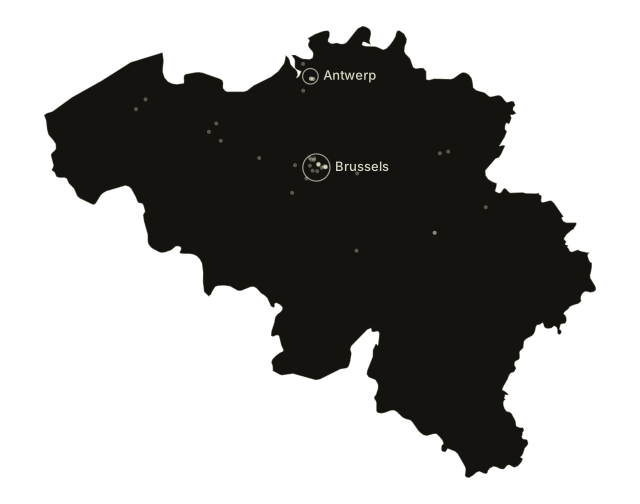
Map: Natural Earth
Remote Hands
Remote Hands in Belgium
Remote hands in Belgium means a Reboot Monkey engineer is dispatched to your facility to carry out physical tasks on your instruction: reboots, cable checks, component swaps and visual checks. Work that needs diagnostic judgement and configuration knowledge is handled as smart hands.
9
of our services in Belgium
Choose your city
Services in Remote Hands
In depth
Remote Hands: 7 sections, open any to read more.
Remote Hands in Belgium: How It Works
Remote hands is the service a business uses when equipment in a data centre in Belgium needs a physical action and the people who manage that equipment are somewhere else. Reboot Monkey defines it narrowly and in operational terms: physical tasks carried out on the customer's instruction, such as reboots, cable checks, component swaps and visual checks. The customer decides what is done and on which device, and a Reboot Monkey engineer carries out that instruction at the rack. The work is physical and bounded by the instruction: it happens at the equipment, in the customer's rack. The name refers to the customer's position: the customer is remote from the equipment, and the engineer acts as the customer's hands at the rack.
The instruction is what defines the service. Where a task needs diagnostic judgement and configuration knowledge, Reboot Monkey treats it as smart hands, which has its own definition and is a different service. Keeping the two apart makes a request easier to scope. An instruction to reboot a named server or to check that a named cable is seated is remote hands. Finding out why a link behaves unpredictably is smart hands, because the engineer has to decide what to examine next. The difference is how much of the decision the customer has already made.
Reboot Monkey is a third-party datacenter services operator. It is not a hosting company and it does not own datacenters, so remote hands in Belgium is delivered as a service attached to the customer's own equipment and rack, not as part of a hosting package.
A request is easiest to carry out when it names the device, the rack and the action in plain terms. A reboot should say which device is to be restarted and whether other equipment depends on it. A cable check should say which cable and which ports are involved. A component swap should say which part is being replaced and where the replacement part will come from. A visual check should say what is to be looked at and what the customer expects to see. The engineer then works from what the instruction says, and anything outside it is a separate request. Written this way, the instruction is also a record the customer can compare with what was done.
Because remote hands is defined by instruction rather than by outcome, the instruction is the unit of work: one task, on one named device, with one action.
A request for remote hands in Belgium moves through these steps:
- The customer sends the instruction: the task, the device and the rack it concerns.
- Reboot Monkey assigns a field engineer, who is dispatched to the customer's facility.
- The engineer carries out the instructed task at the customer's equipment, whether a reboot, a cable check, a component swap or a visual check.
- The customer decides whether further work is needed and raises it as a new instruction.
Datacenter Landscape in Belgium
Data centres in Belgium, ordered by the number of networks present:
- Digital Realty BRU1 - Brussels, Wezenbeekstraat 2, Zaventem, 1930 Brussels: 103 networks; carriers Arcadiz, Arelion, Eurofiber, LASOTEL, NL-ix and others
- LCL Brussels (Diegem) (LCL Belgium), Kouterveldstraat 13, Diegem, 1831 Brussels: 47 networks; carriers Arcadiz and Eurofiber
- Level(3) Brussels (Colt Technology Services Group), Leon Grosjeanlaan 2, 1140 Brussels: 21 networks; carriers Arelion, Colt Technology Services and Eurofiber
- antwerpdc (Datacenter United), Häifastraat 6, 2030 Antwerp: 17 networks; carriers Arcadiz and Eurofiber
- brusselsdc (Datacenter United), Excelsiorlaan 15, 1930 Zaventem: 16 networks; carriers Eurofiber and Free Pro
- Digital Realty BRU3 - Brussels, Mercuriusstraat 27, 1930 Zaventem: 15 networks; carriers Arcadiz
- LCL Antwerp (LCL Belgium), Noorderlaan 133, 2000 Antwerp: 15 networks; carriers Eurofiber and RETN
- Unix-Solutions DC Zaventem (Unix-Solutions BV), Hoge Wei 37, 1930 Zaventem: 13 networks; carriers Arcadiz
- WDC, Rue de la Metallurgie 17, 4530 Villers-le-Bouillet: 12 networks; carriers Arcadiz and Eurofiber
- LCL Wallonia One (LCL Belgium), Rue Guillaume Fouquet 14, 5032 Gembloux: 11 networks; carriers Arcadiz
Remote Hands by City
City pages for remote hands in Belgium:
- Brussels: https://www.rebootmonkey.com/en/belgium/brussels/remote-hands/
Remote Hands in Belgium: What We Deliver
Four task types make up remote hands, and each has a specific meaning at the equipment. A reboot restarts a server or network device that the customer has identified by name and by position in the rack. It applies when a device has stopped responding and when a device has to be restarted after a change the customer has made. The engineer works at the device itself. Each task is physical and is done at the rack, which is why remote hands needs an engineer at the equipment.
A cable check examines the cabling attached to a device or running between devices and confirms its state against the instruction. Where optical links are involved, a fibre inspection scope and cleaning kit are available on request, so a fibre connector can be inspected and cleaned as part of the task. An inspection scope shows the condition of a connector end, and the cleaning kit is used to clean it before the connection is made again. The check is bounded by the instruction, so each cable or link to be examined is named in it.
A component swap replaces a part in a device, such as a failed module, with the replacement part that the instruction identifies. The engineer carries out the replacement at the rack; deciding which part has failed and why is diagnostic work, and that belongs to smart hands. A swap stays within the part the instruction names.
A visual check is the engineer looking at the equipment, its cabling and its indicators at the rack and confirming what is seen against the instruction. It applies when the customer needs the state of a device at the rack established by someone present.
On-site IT support in Belgium data centers, as Reboot Monkey delivers it, means a field engineer dispatched to the customer's facility to work at the customer's equipment: on an instruction for remote hands, or on a smart hands request when the work needs judgement. The task and the equipment come from the customer, and the engineer and the dispatch come from Reboot Monkey.
Around the rack, Reboot Monkey sells the following:
- Rack space: the space where the customer's equipment sits, and where each remote hands task is carried out by the engineer dispatched for it.
- IP transit and leased IP addresses: connectivity and addressing that Reboot Monkey sells for the equipment in the rack.
- Network: Reboot Monkey orders the cross connects and carrier circuits from the facility operator and the carriers present in the facility, and Reboot Monkey engineers install and patch the cabling in the customer's rack. A cross connect is a physical link between two points inside the facility, and a carrier circuit is the connection supplied by a carrier present in the facility.
- Data-centre hardware: sold together with the services that deliver, install and support it, so the same operator can supply a device and later carry out component swaps on it.
Why Reboot Monkey for Remote Hands in Belgium
The facility operator owns and runs the building, including its power, cooling and access policy, and Reboot Monkey engineers work under the operator's site rules.
A second, briefed Reboot Monkey engineer is named as backup for every customer site. The backup has already been briefed on the site, so if the first engineer cannot attend, an instruction does not have to be explained again from the beginning. This applies to remote hands in the same way as to the other services Reboot Monkey provides.
As of 2026, Reboot Monkey's field engineers work in 190 countries and more than 400 locations. A customer with equipment in several countries can write its instructions in the same form, because the definitions of the services do not change from one place to another. Wherever the work is carried out, a remote hands request is a physical task on the customer's instruction.
Prices are quoted on request and depend on the customer and the size of the job. A request that lists the tasks, the equipment and the sites involved gives Reboot Monkey what it needs to size the job. Because a remote hands task is defined by the instruction, the instruction is also the basis for the quote: a short, exact request is easier to size than a broad one. The quote therefore reflects the job described, and a customer with several sites can set them out in one request.
Responsibility for the purpose and configuration of the equipment stays with the customer. Reboot Monkey supplies the engineer, the dispatch of that engineer to the customer's facility, and the cabling work in the customer's rack. The engineer acts on the instruction and does not take over decisions about how the equipment is used.
Choosing between the neighbouring services depends on what the customer already knows. If the customer can name the device and the action, the request is remote hands. Remote hands is the narrowest of them, since it asks for no diagnosis and no installation. If the cause of a problem is not yet known, the work needs judgement and is scoped as smart hands. If the equipment is new, is moving or is leaving service, a different service applies, and each one is defined by the work it covers:
- Smart hands: technical work that needs diagnostic judgement and configuration knowledge.
- Rack and stack: installing, mounting and cabling new hardware.
- Server migration: moving equipment between racks, rooms or facilities.
- Data center decommissioning: removing and disposing of retired hardware.
- IT asset disposition (ITAD): data wiping, on-site shredding or degaussing, collection and transport, and resale or buyback quoted case by case, all processed by Reboot Monkey staff in a partner's processing facility or on the customer's site.
- Hardware monitoring: monitoring of the customer's servers and network equipment by the Reboot Monkey NOC.
How Reboot Monkey Works
These terms apply in every facility in Belgium where Reboot Monkey engineers work.
- Response: 1-hour, around-the-clock incident response SLA, and a 15 minute premium response available where technicians are stationed on-site, as a paid add-on. The incident response SLA covers incidents and unplanned requests; on-site, dispatch and resolution times, priority tiers, and planned or scheduled work are agreed per site in the service agreement.
- Monitoring: 24/7 NOC monitoring across all facilities, covering IPMI, iDRAC, SNMP, temperature, power, network signals.
- Hardware: vendor-neutral technicians for Dell, HP, Cisco, Juniper and Arista equipment.
- Independence: independent from facility operators (not Equinix SmartHands, not NTT staff).
- One agreement: single provider across cities, so a customer in several cities needs only one agreement.
- Service levels and terms: https://www.rebootmonkey.com/en/solutions/sla
- Published case study: a major ICT provider engaged Reboot Monkey for three full infrastructure rollouts in Lahore, Karachi and Islamabad, with the hardware installed the same day at every site. Read the case study at https://www.rebootmonkey.com/en/resources/case-study/how-we-completed-3-full-deployments-across-pakistan
Remote Hands
The data centres we work in hold their own certifications, such as ISO/IEC 27001 and ISO 9001. Ask us for the certificate of your site.
Frequently Asked Questions
What does remote hands cover in Belgium?
Remote hands covers physical tasks carried out on the customer's instruction: reboots, cable checks, component swaps and visual checks. A Reboot Monkey engineer is dispatched to the customer's facility in Belgium to carry out the task at the equipment. Work that needs diagnostic judgement and configuration knowledge is not remote hands. It is handled as smart hands, which is a separate service.
Do you provide on-site IT support in Belgium data centers?
Yes. Reboot Monkey field engineers are dispatched to the customer's facility and work at the customer's own equipment. The work ranges from instruction-led remote hands to smart hands for tasks that need diagnostic judgement. It also includes installing and patching cabling in the customer's rack, rack and stack of new hardware, and moving equipment between racks, rooms or facilities. Each request starts with the customer describing the task.
Do you work in every datacenter in Belgium?
Reboot Monkey engineers work in any facility in Belgium where the customer has equipment and access, under the operator's own access and safety rules. The customer adds the engineers to the facility's access list before the first visit.
How fast can Reboot Monkey respond in Belgium?
Incidents and unplanned requests are handled under a 1-hour, around-the-clock incident response SLA. There is also a 15 minute premium response available where technicians are stationed on-site, as a paid add-on. On-site, dispatch and resolution times, priority tiers, and planned or scheduled work are agreed per site in the service agreement.
How is Reboot Monkey different from the facility operator's own staff?
Facility operators' own technicians work for the building. Reboot Monkey engineers work for the customer: they are independent from facility operators (not Equinix SmartHands, not NTT staff), follow the customer's instructions, and the same team can cover several buildings in the country under one agreement.
How do I get started with remote hands in Belgium?
Send the site, the equipment and the task through the contact form. Reboot Monkey replies with a quote and an engineer plan for that facility. Once agreed, the customer adds the engineers to the facility's access list and the remote hands work is scheduled under the operator's rules.
Cities we cover in Belgium
Request Remote Hands in Belgium
Describe the tasks, the equipment and the sites involved, and Reboot Monkey will quote the job on request.